


The Defense Department’s strategy of flipping the bird to judges while insisting that they’re just scratching their eyebrow with their middle finger continues to pay off bigly. For the second time in a month, Judge Paul Friedman voided the Pentagon’s press policy and ordered DoD to let reporters back in the building. And, once again, it was Pentagon leadership shooting their mouths off that did them in.
“The Department cannot simply reinstate an unlawful policy under the guise of taking ‘new’ action and expect the Court to look the other way,” Judge Friedman wrote. “Nor can the Department take steps to circumvent the Court’s injunction and expect the Court to turn a blind eye.”
There may be no member of the Trump administration who hates the media more than Defense Secretary Pete Hegseth. The former Fox News weekend host — ironic, isn’t it? — suffered a humiliating confirmation process, during which revelations of his drunkenness, infidelity, and utter lack of managerial skills dominated the headlines.
Once in office, he took immediate steps to evict mainstream media outlets from the building. In September, he rolled out a new policy for the Pentagon press corps, requiring journalists to agree not to solicit or publish any “unauthorized” information in exchange for access to the building.
In October, reporters surrendered their Pentagon Facilities Alternate Credentials (PFACs) en masse after refusing to become glorified stenographers.
They were replaced by a parade of rightwing shit-stirrers, like Laura Loomer, Mike Lindell, and Tim Pool, whom Pentagon Press Secretary Kingsley Wilson greeted as the “next generation.”
“The legacy media chose to self-deport,” she sneered, adding that “It’s disgraceful that they call themselves journalists and we told them as such, right?”
This frank admission that the actual journalists — including Fox and Newsmax — had been booted based on their First Amendment protected speech featured prominently in Judge Friedman’s March 20 grant of summary judgment in favor of the New York Times.
“In sum, the undisputed evidence reflects the Policy’s true purpose and practical effect: to weed out disfavored journalists—those who were not, in the Department’s view, ‘on board and willing to serve,’ —and replace them with news entities that are,” he concluded. “That is viewpoint discrimination, full stop.”
The government requested that the court allow it to go back and clarify the policy, but the court refused, finding that vacatur was the only appropriate remedy. And yet, just four days later, the Department issued a “revised” interim policy that looked quite familiar.
The new policy banished reporters from the historic Correspondents’ Corridor and relocated them to a Pentagon library annex that, at the time of the ruling, had not yet opened. In the meantime, credentialed journalists could access the main building only if they had a scheduled, approved appointment and were escorted at all times. NYT reporter Julian Barnes, a veteran Pentagon correspondent, showed up for a pre-approved interview on March 31, arrived early, showed his credentials, and was immediately ejected from the building because PFAC holders must enter through Corridor 8, not the Visitor’s Center where his escort was supposed to meet him. His interview was then postponed.
DOJ smirked that the physical access restrictions weren’t covered by the original order, the new credentialing language was “meaningfully different” from the old language, and anyway the press library has WiFi. They also complained that NYT filed a motion to compel without conferring — which is kind of amazing when your last email ended with “we will not address your arguments in response in any motion you may file.”
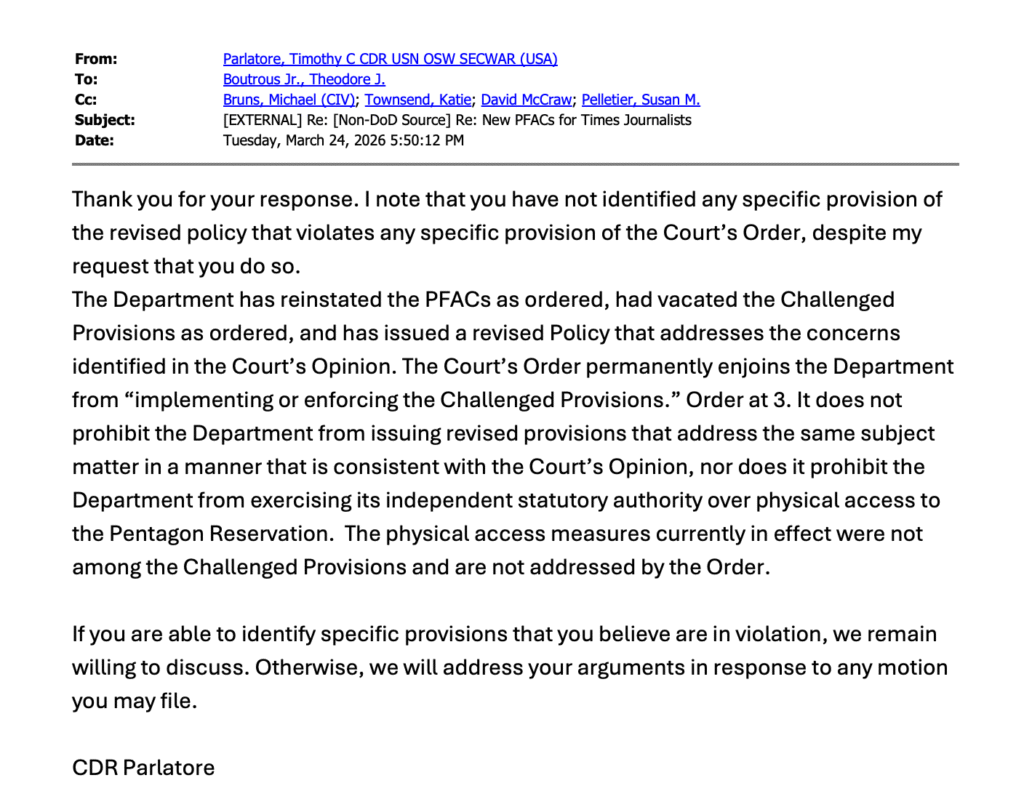
Commander Timothy Parlatore, the policy’s architect and DOD’s own counsel, gave the game away when he admitted that the new policy “used more words to say the same thing.”
But even if Parlatore had the ability to clamp it, the outcome would have been the same. Replacing the prohibition on “soliciting” non-public or unauthorized classified or unclassified information with a prohibition on “encouraging, inducing, or requesting” it yet another middle finger — albeit one gesturing toward a thesaurus.
The judge was not amused:
The Court cannot conclude this Opinion without noting once again what this case is really about: the attempt by the Secretary of Defense to dictate the information received by the American people, to control the message so that the public hears and sees only what the Secretary and the Trump Administration want them to hear and see. The Constitution demands better. The American public demands better, too.
Naturally the Department has appealed.
Liz Dye produces the Law and Chaos Substack and podcast. You can subscribe by clicking the logo:
The post Defense Department Lawyering Almost As Good As Hegseth’s Pullups appeared first on Above the Law.
