 Skip to content
A running-calorie estimate needs both a clear description of the run and a clear definition of the output. Faster pace, longer distance, and longer duration are related but not identical. A calculator cannot tell exactly how much energy you used from a finish time alone.
Separate pace, speed, and distance
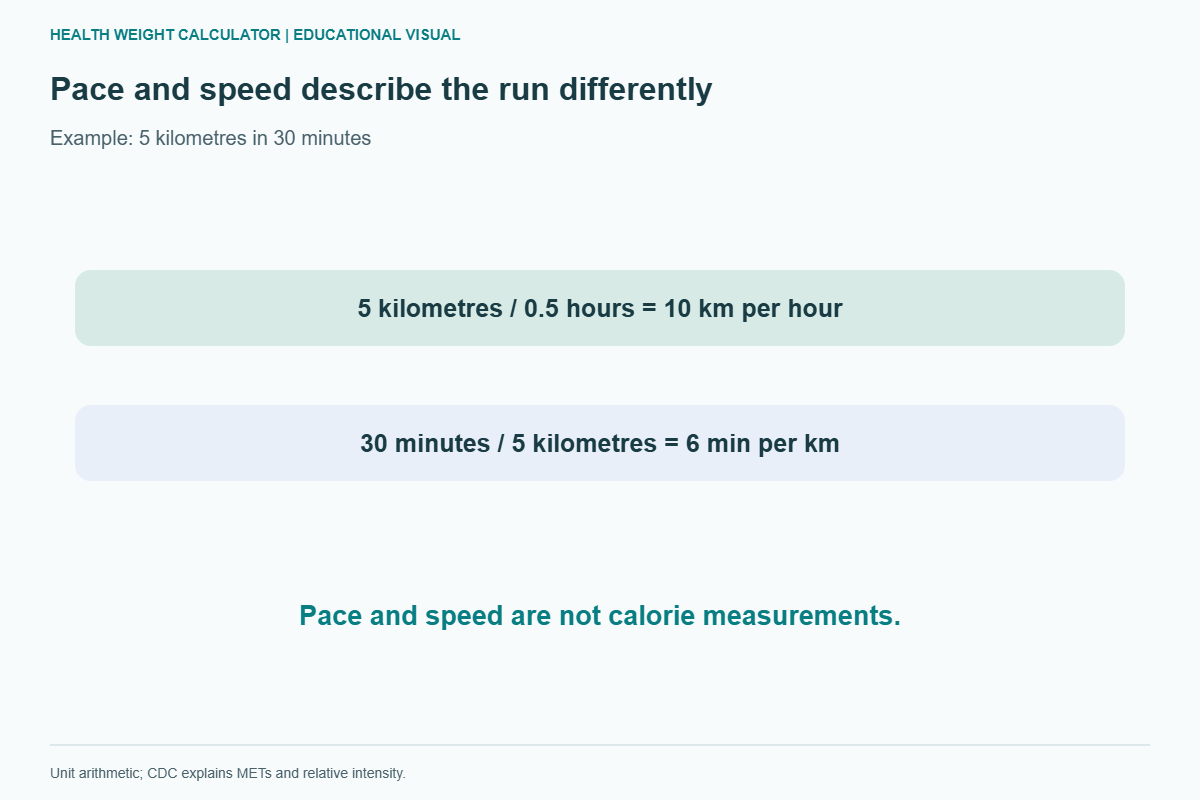
Pace is time per unit of distance; speed is distance per unit of time. A 5 km run in 30 minutes has an average pace of 6 minutes per kilometre and an average speed of 10 km per hour. This arithmetic describes the run, not the runner’s personal calorie expenditure.
At the same distance, a faster pace reduces duration. At the same duration, a faster pace covers more distance. Comparing estimates without specifying which is held constant can create misleading claims about the value of running faster.
Know what the model leaves out
Calculators may use a reference MET, an equation based on mass and distance, or device data. Hills, terrain, wind, carried load, movement efficiency, and individual physiology can affect energy use. A flat-road entry may not describe a trail run well.
CDC explains the difference between absolute intensity, such as METs, and relative intensity, or how hard the activity feels to you. A reference value is not a measurement of your individual oxygen use.
Gross and active calories are different
Gross session energy includes resting expenditure during the time spent running. An active or net estimate attempts to describe activity above a resting baseline, although device terminology varies. Read the definition before comparing two outputs or adding one to a daily-needs estimate.
If a daily activity factor already includes your training, adding full workout calories again may double count. Our workout-calorie guide explores that issue, and our BMR article covers resting expenditure.
Train for a manageable effort
Do not increase speed or mileage just to make a tracker display more calories. Build gradually, allow recovery, and adapt for pain, illness, or health conditions. Benefits include endurance and daily function; they do not depend on achieving a particular weight-loss number.
Stop and seek appropriate care for chest pain, fainting, or severe unusual symptoms. A training target should never override safety.
Questions readers ask
Can two runners burn different amounts on the same route?
Yes. Body size and other factors differ, and both displayed estimates may be uncertain.
Should I subtract the watch reading from food intake?
Not automatically. It may overlap with your daily estimate and is not exact.
Sources
General adult education, not measured energy expenditure or a running prescription.
Short visual recap
Visual recap transcript
A running-calorie estimate needs both a clear description of the run and a clear definition of the output. Faster pace, longer distance, and longer duration are related but not identical. A calculator cannot tell exactly how much energy you used from a finish time alone.
Pace and speed describe the run differently. Five kilometres in thirty minutes is ten kilometres per hour or six minutes per kilometre.
Yes. Body size and other factors differ, and both displayed estimates may be uncertain.
