 Skip to content
There is no walking duration that guarantees weight loss for every person. A useful walking plan balances your starting ability, health, available time, and enjoyment. Walking can improve health and function even when the scale does not fall.
Understand the weekly health recommendation
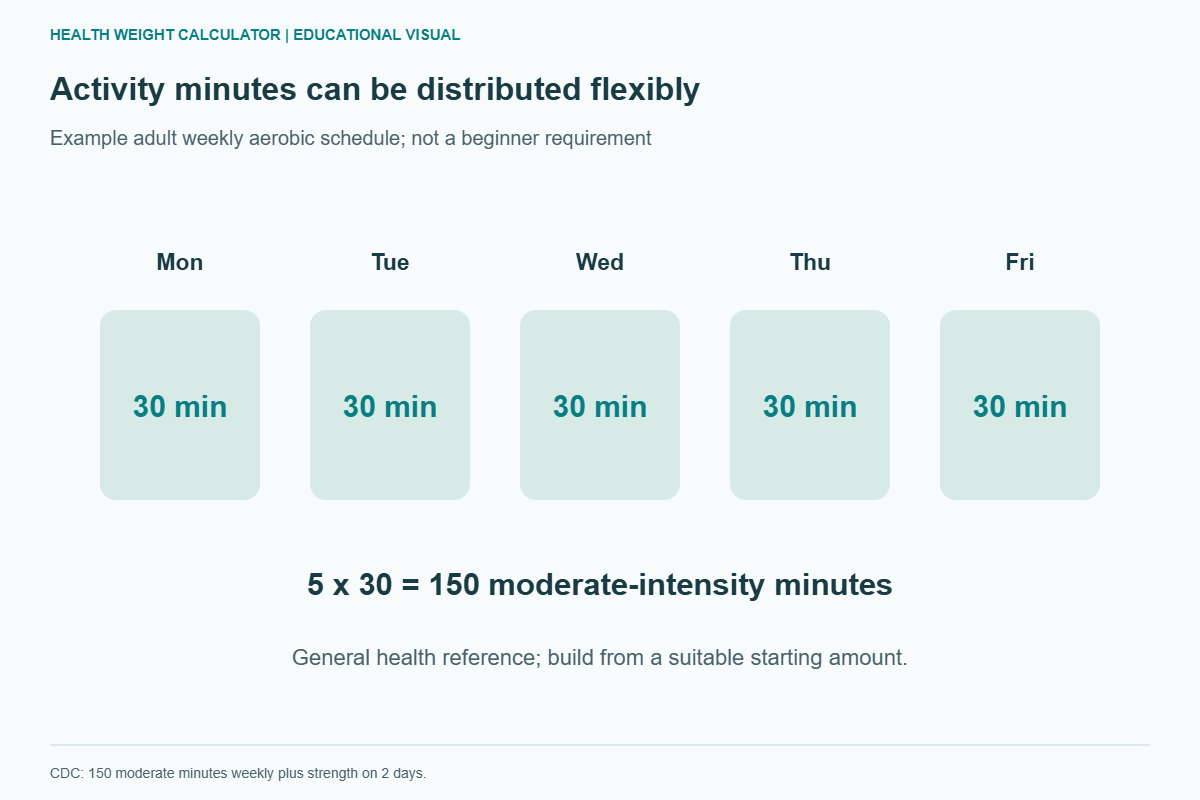
CDC recommends at least 150 minutes of moderate-intensity aerobic activity weekly for adults, or an equivalent vigorous mix, plus strengthening on two days. Thirty minutes on five days is one way to distribute 150 minutes, but it is not the only schedule or a compulsory starting amount.
Shorter periods can fit into daily life. If you are currently inactive, begin with a manageable amount rather than treating the guideline as a pass-or-fail test. Some activity is better than none.
Use effort rather than a universal speed
A brisk pace depends on the person. CDC’s talk test suggests that moderate effort allows talking but not singing. A fixed speed can feel very different with hills, heat, fitness differences, or a medical condition.
Do not force a pace that feels unsafe because a device labels it moderate. Ask about adaptations if pain, balance, or breathlessness limits activity. Walking may not be the best option for everyone; other suitable activities can count too.
Build walking around existing opportunities
- A short break during work or study.
- A comfortable route after a meal, where appropriate.
- A walk with a friend or family member.
- An indoor option when weather or safety makes outdoor walking difficult.
These are ideas, not prescribed amounts. Choose a route and time you can repeat. Increase duration or pace gradually rather than changing both sharply at once.
Track more than kilograms
Notice improved comfort on a familiar route, less fatigue during daily tasks, or enjoyment and mood. Weight also depends on intake, water changes, medicines, and health. A weekly walking total cannot predict exactly how those influences combine.
If a tracker is useful, compare the same device over time without treating its calories as precise. Our workout-calorie guide explains the uncertainty. The BMR article explains why resting needs are not total daily expenditure.
Questions readers ask
Do I have to walk every day?
No universal schedule applies. Spread activity in a way that supports recovery and your circumstances.
Do I need 10,000 steps?
No fixed step count guarantees weight loss or defines whether your effort counts.
When should I stop?
Stop for concerning symptoms and seek appropriate care, especially for chest pain, fainting, or severe unusual breathlessness.
Sources
- CDC: Weekly Adult Activity Guidance
- CDC: Talk Test and Relative Effort
- NIDDK: Health Benefits and Accessible Activity
General adult education, not an individualized walking or weight-loss prescription.
Short visual recap
Visual recap transcript
There is no walking duration that guarantees weight loss for every person. A useful walking plan balances your starting ability, health, available time, and enjoyment. Walking can improve health and function even when the scale does not fall.
Activity minutes can be distributed flexibly. Five thirty-minute moderate sessions total 150 minutes; this is one optional schedule.
No universal schedule applies. Spread activity in a way that supports recovery and your circumstances.
