 Skip to content
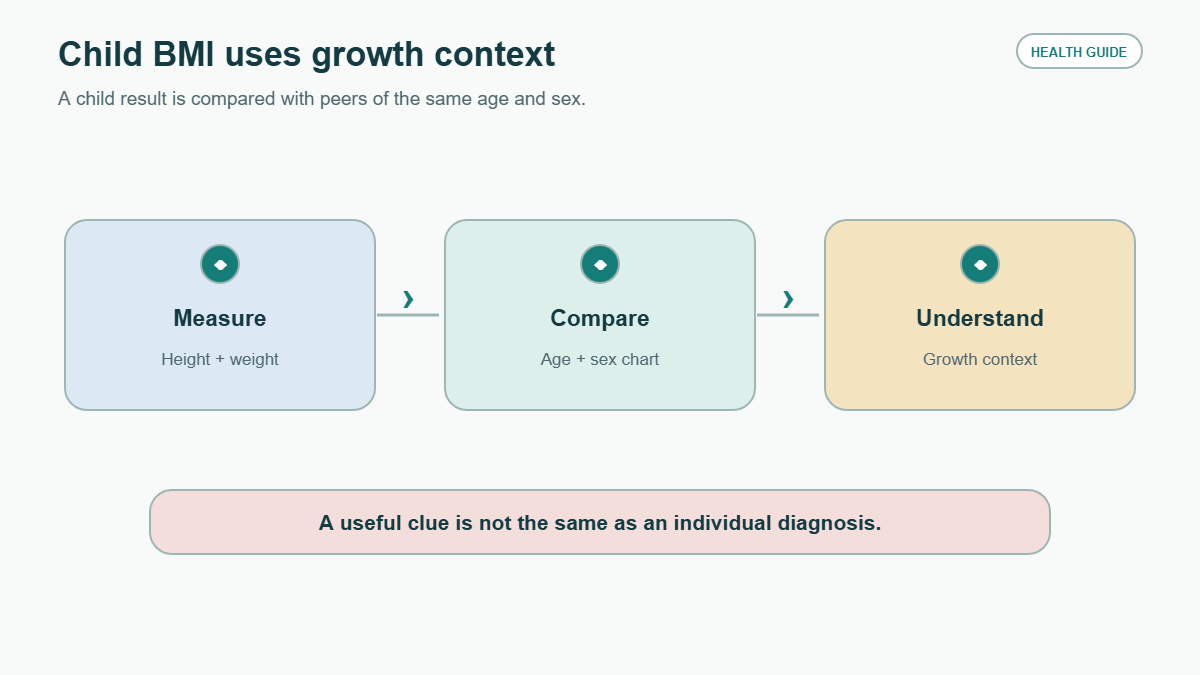
When you check a child’s BMI, the result is not interpreted like an adult’s. Growth changes with age, so clinicians use BMI-for-age percentiles and consider the child’s broader growth pattern.
What a child BMI percentile means
BMI is calculated from weight and height. For children and teens, the number changes as they grow, so it is interpreted using BMI-for-age growth charts rather than the fixed adult categories. A percentile compares the child’s BMI with the reference distribution for children of the same age and sex. For example, a percentile describes where a value falls in that reference group; it does not mean that a child has that percentage of body fat.
The US Centers for Disease Control and Prevention (CDC) provides a calculator for children and teens ages 2 through 19. Its result includes BMI, percentile, and a screening category. The CDC notes that rounding age, height, and weight differently can produce small differences between calculators. Use a consistent, trusted tool and treat the result as an estimate.
The CDC uses BMI-for-age percentile bands to describe screening categories for children and teens: below the 5th percentile is underweight; the 5th to below the 85th is healthy weight; the 85th to below the 95th is overweight; and the 95th percentile or higher is obesity. The category is based on the appropriate age- and sex-specific reference and should be interpreted with a clinician, not used as a diagnosis.
How to get a useful estimate
- Use a recent measurement. Measure height without shoes and use a reliable scale on a firm, level surface. Follow the CDC’s child height and weight measurement guidance.
- Enter the correct age and chart information. The CDC calculator is designed for ages 2–19 and uses age- and sex-specific growth references. If the calculator’s required information does not fit your child’s situation, ask a pediatric health professional how to interpret it rather than guessing.
- Review the result in context. Growth over time, development, medical history, family context, and other clinical findings matter. A single percentile cannot explain why a child is growing a certain way.
Why this is not a diagnosis
BMI does not directly measure body fat or distinguish fat, muscle, and bone. The CDC describes BMI as one potential health indicator and recommends considering other information, such as health history, behaviors, physical examination, and laboratory findings when appropriate. A clinician can interpret the child’s growth pattern and decide whether any follow-up is useful. Avoid putting a child on a restrictive diet based on a calculator result; discuss concerns with a qualified professional.
For more background, see our healthy weight guide and tools and calculators. These resources are informational and do not replace pediatric care.
Short video: three steps for reading the result
Frequently asked questions
Is a child BMI percentile the same as body-fat percentage?
No. It compares BMI with a reference group of children of the same age and sex. It does not report the percentage of body fat.
Can I use an adult BMI chart for a child?
No. Adult BMI categories are not the right interpretation for children and teens. Use a child-specific BMI-for-age reference, such as the CDC tool for ages 2–19, and ask a clinician about results.
Should one result determine whether my child is healthy?
No. It is a screening result. A qualified health professional can consider the child’s growth over time and the broader health picture.
Sources
Health information only; not a diagnosis or personalized medical advice. For questions about an individual child’s growth, speak with a pediatric clinician.

Pingback: Teen Weight Loss Calculator Safe | Health Weight Calculator