 Skip to content
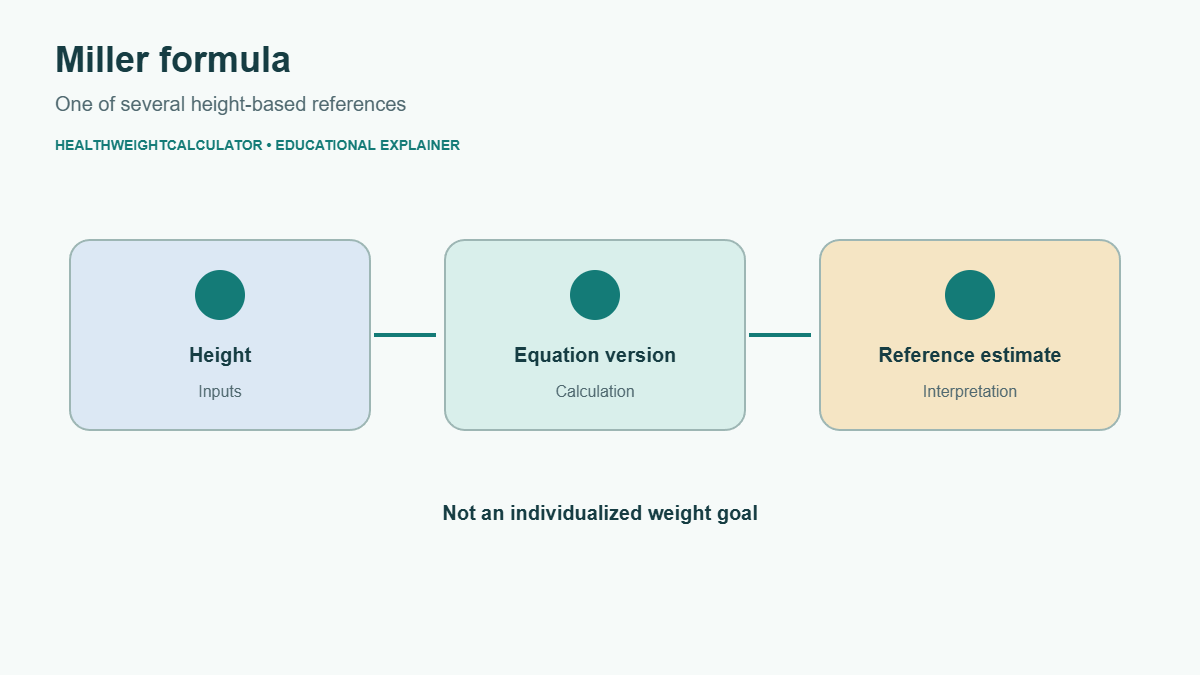
The Miller formula is one of several equations that estimate a reference or “ideal” body weight from height. A commonly cited version uses 56.2 kg plus 1.41 kg for each inch above 5 feet for men, and 53.1 kg plus 1.36 kg per inch for women. Calculators may use converted values, different rounding, or another rule for heights below 5 feet; review the stated method.
What a height-based formula leaves out
The equation does not directly measure body composition, nutrition, or health. It cannot account for a person’s medical history, age, or individual goals. The word “ideal” can imply more certainty than the formula provides: its output is a reference estimate, not a personalized target.
Use the result responsibly
Healthcare professionals may use weight equations in a defined clinical context, but an online calculator does not know which protocol applies. Never use a height-based estimate to change a medication dose or begin a restrictive eating plan. If you are considering a weight goal, discuss it with a qualified healthcare professional who can consider your circumstances.
The CDC explains that BMI is a screening tool and does not distinguish fat, muscle, and bone. A different equation has different assumptions; it still cannot replace clinical interpretation. Compare the Hamwi formula and Devine formula guides to see why equations can produce different reference values.
Common questions
Is the Miller result my ideal weight?
No. It is an estimate from a formula and not a personal recommendation.
Why do calculators disagree?
They may use different coefficients, unit conversions, or rounding conventions.
Can I use the result for dosing?
No. Follow the prescriber and relevant clinical protocol.
Sources
Educational information only; not a diagnosis or personal weight goal.
