
A “substantial anti-Trump youth movement” is missing, argues New York Times columnist Thomas B. Edsall, warning that apathy, social media, and artificial intelligence may be leading to the deterioration of American exceptionalism and democracy.
“We have a president who has directly attacked the finances and the intellectual freedom of colleges and universities, is building the technology for a surveillance state, undermines free and fair elections and took the nation into an unjustified war with no explanation while causing domestic economic havoc,” Edsall writes. “But one ingredient is missing: a substantial anti-Trump youth movement.”
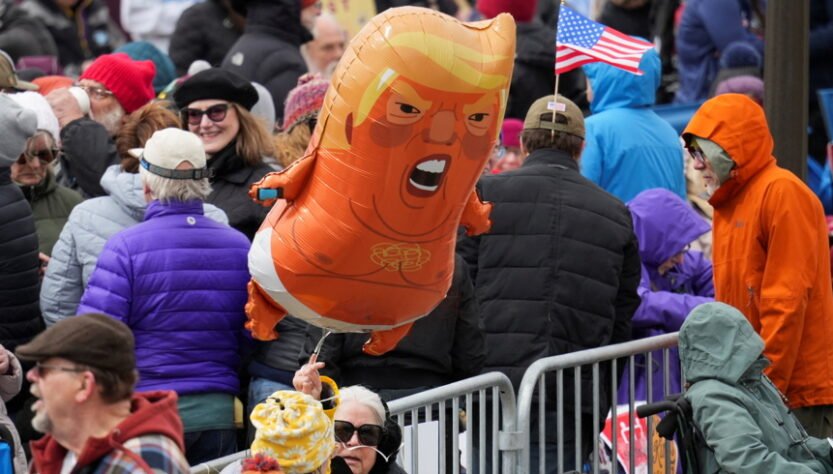
Edsall suggests that the “No Kings” movement is increasingly comprised of a demographic that is older than students and younger men and women.
Asked about their mobilization, Dana Fisher, a professor in the School of International Service at American University, said, “We’re not seeing them in the streets at No Kings events.”
“At No Kings 1 (June 14, 2025) the median age was 36,” Fisher wrote, “at No Kings 2 (Oct. 18, 2025) the median age was 44, and at No Kings 3 (March 28, 2026) it was 48. Clearly, it’s getting older.”
Asking why, Edsall writes he spoke with experts who “pointed to such structural developments as the explosion in social media usage and public access to artificial intelligence, both of which weaken users’ sense of efficacy and agency.”
Democrats will bear the brunt of the cost of social media and artificial intelligence, given that those “adverse effects are most acute for young liberals, especially young liberal women.”
There are other factors at work.
Sociology professor emeritus Richard Braungart “argued in an email that over 70 years the United States has undergone a moral and ideological transformation that has created a hostile environment for the liberal activist young.”
Braungart posited that there “is a widening gap and split between spirituality and materialism in our society today.”
He pointed to his youth, “a world of moral and spiritual values (Marshall Plan, U.S.A.I.D., CARE, good government that served the people), which, unlike today, heavily influenced political decisions. Politicians were held accountable for their moral lapses and flagrant violations.”
But now, “Americans are living in a crumbling moral wasteland, where corruption and raw-power politics rule supreme and are carried out without ethics, morality, personal responsibility, accountability, nor concern for people, the environment and a healthy future for upcoming generations.”
Social psychologist Jonathan Haidt also points to social media, arguing that it “has done more harm to the Democrats than to the Republicans, both by weakening their young people (e.g., their requests for trigger warnings and safe spaces) and also by radicalizing them. They in turn push the party to take more extreme cultural positions, which drive noncollege voters to the right.”
Haidt has more to say about social media, and specifically about short-video platforms.
“I believe that TikTok, Instagram Reels, and YouTube Shorts are bringing America a cognitive catastrophe,” he writes. “The diminishment of capability is hitting both sides, but it is the left that most needs its young people to come out and fight for change.”
Edsall has a warning: “As apathy spreads, the ability of authoritarian leaders in the Trump mold to smash democratic norms and wrest control of elections will grow stronger.”
Image via Reuters
There’s a reason 10,000 people subscribe to NCRM. You can get the news before it breaks just by subscribing, plus you can learn something new every day.