

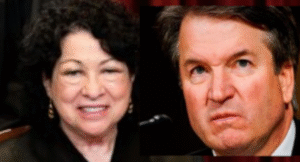
On Wednesday, Justice Sonia Sotomayor publicly apologized to Justice Brett Kavanaugh for her “hurtful” and “inappropriate” remarks at a University of Kansas law school event last week that kicked a hornet’s nest of media attention framing her comments as rare and unusual. Specifically, Justice Sotomayor remarked — without naming Kavanaugh — that, “I had a colleague in that case who wrote, you know, these are only ‘temporary stops.’ This is from a man whose parents were professionals. And probably doesn’t really know any person who works by the hour.”
And for that, Justice Sotomayor apologized. Justice Kavanaugh, meanwhile, is not under any pressure to do anything about greenlighting a new wave of racial profiling.
It’s a reminder that the Supreme Court — and Supreme Court coverage — consistently gets more worked up over possible behind-the-scenes drama than the Court reshaping basic civil rights. It’s also a reminder that conservatives are the biggest snowflakes in the world.
Sotomayor’s University of Kansas remarks referred to Kavanaugh’s concurrence in Noem v. Vasquez Perdomo, the September 2025 shadow docket order inventing the ICE enforcement tactics we now shorthand as “Kavanaugh Stops” in academic literature, legal journalism, and basically everywhere except the chambers of Justice Brett Kavanaugh. Kavanaugh used the Court’s emergency docket to lay out — without full briefing or argument — a new law enforcement standard that racial profiling is perfectly fine as long as the minority is also speaking Spanish and working a job that involves a wrench. To be precise, Kavanaugh explained that race can motivate a law enforcement stop if it appears that the minority works “in certain kinds of jobs, such as day labor, landscaping, agriculture, and construction, that do not require paperwork and are therefore especially attractive to illegal immigrants.”
In Brett Kavanaugh’s America, the Fourth Amendment requires a credit check. If you’re Latino right now and you don’t want to find yourself in an El Salvadoran prison by mistake, the best legal advice is to wear a top hat and monocle everywhere you go.
Kavanaugh, writing alone, reassured the public that these stops would be “typically brief” and that U.S. citizens would “promptly go free” once they produced proof of their citizenship. This was, as our colleague Liz Dye put it at the time, horseshit. It remained horseshit 50 days later, when the count of detained U.S. citizens cleared 170. The record in the underlying case included plaintiffs who had been pushed against fences, zip-tied, held for days in unsanitary facilities, denied phone calls, and had their documentation dismissed on the ground they didn’t “look like” their names. Army veteran George Retes. Nineteen-year-old Jose Hermosillo. Julio Noriega. Maria Greeley. Twenty-plus detained children. The Stanford Law Review just published a full-dress legal autopsy of Kavanaugh’s concurrence under the title “Factual Revisionism.”
Against that record, saying Justice Keggy McAssaulterton might “not know any person who works by the hour” was beyond fair for a guy declaring that the entire construction industry is inherently suspect. Saying “race plus looks blue collar equals reasonable suspicion” was a constitutional reboot. Only one of those things got an apology this week.
The reaction to Sotomayor’s original remarks reflect the media’s desperate desire to rebrand legal coverage as The Real Supreme Court Justices Of One First. The decisions are just McGuffins setting up the next gossipy tale of behind-the-scenes tension, which is itself the most obnoxious part of the Supreme Court beat but for the companion narrative of “look at how they’re really all best friends!” Leaks, drama, reconciliation, and a collegiality reunion special replacing Andy Cohen with some T14 law school dean — it’s the circle of Supreme Court coverage life. It’s all distraction. Bread and circuses updated for 2026 America as Big Macs and Big Brother.
Sotomayor’s candor becomes the real disruption rather than the topic she was candid about. And that framing contributed to this apology. And coverage of this apology will now double down on the idea that her comments were the problem as opposed to a refreshingly straightforward account of the substantive shitshow Kavanaugh unleashed when he decided ICE can arbitrarily harass any Brown person with a landscaping business.
As Jay Willis of Balls & Strikes notes, Sotomayor’s apology provides a depressing counterpoint to the latest out of Clarence Thomas. On the same day that Sotomayor felt the need — or, perhaps, was pressured? — to apologize, Thomas delivered a televised broadside declaring that “progressivism” seeks to “replace the basic premises of the Declaration of Independence” and holds a spirit of “cynicism, rejection, hostility and animus” toward America. He is almost certainly not apologizing any time soon. Sam Alito is out here flying insurrection-curious flags and also never apologized. Though he did throw his wife under the bus over it.
To borrow from a movie about a Harvard Law student, conservatism means never having to say you’re sorry.
The obsession with Supreme Court decorum is a one-way street, which is a feature, not a bug. The more violent the impact of a policy, the more aggressively the perpetrators insist on polite treatment for themselves. It’s essential to the project because, one, it’s vital to distract the public from the actual, tangible harm being done with reality show nonsense. The story can’t be “third generation U.S. citizen zip-tied and beaten by ICE because they’re working as a nanny,” it has to be “liberal justice violates the most sacred taboo of America’s judicial system by hurting her colleague’s feelings.”
And two, a fixation with decorum artificially blunts anyone trying to clearly articulate reality. If you call a racial profiling doctrine “a racial-profiling doctrine,” then it crosses the line into “inappropriate.” Call ICE kidnappings of U.S. citizens “kidnappings” and the scolds come out in droves to brand you “uncivil.” Point out that the author of a 10-page concurrence greenlighting all of that probably doesn’t personally know anyone who works by the hour or have a practical grasp of what it’s like to live that life and — well, you saw what happened.
Sotomayor has spoken publicly this month about her earnest belief in maintaining civil relationships with colleagues even when she dissents so much that she’s running out of synonyms for “disgraceful.” Chris Geidner argued that Sotomayor’s apology is strategically sound because Kavanaugh could be a future swing vote. That’s a fair theory, though I’d like to think even the most cynical of justices are going to do what they’re going to do, and not make decisions about the future of constitutional law based on interpersonal beefs. It also overlooks the power of negative reinforcement: showing someone the smoke he might catch for a bad decision can be at least as persuasive.
In any event, Justice Sotomayor has every right to apologize if she feels she crossed a line or her assessment of realpolitik demands it, but if these are her motivations, those are lines she’s drawn for herself. And those lines only run one way.
Justice Sotomayor apologizes to Justice Kavanaugh for public criticism of immigration opinion [ABC News]
Supreme Court Justice Clarence Thomas blasts progressivism as threat to America [ABC News]
 Joe Patrice is a senior editor at Above the Law and co-host of Thinking Like A Lawyer. Feel free to email any tips, questions, or comments. Follow him on Twitter or Bluesky if you’re interested in law, politics, and a healthy dose of college sports news. Joe also serves as a Managing Director at RPN Executive Search.