 Skip to content
It is natural to wonder what today’s health numbers mean for the future. But a person’s lifespan cannot be reliably predicted from body weight alone. A calculator that turns weight into a specific age or number of years would give a false sense of precision.

Why a single number falls short
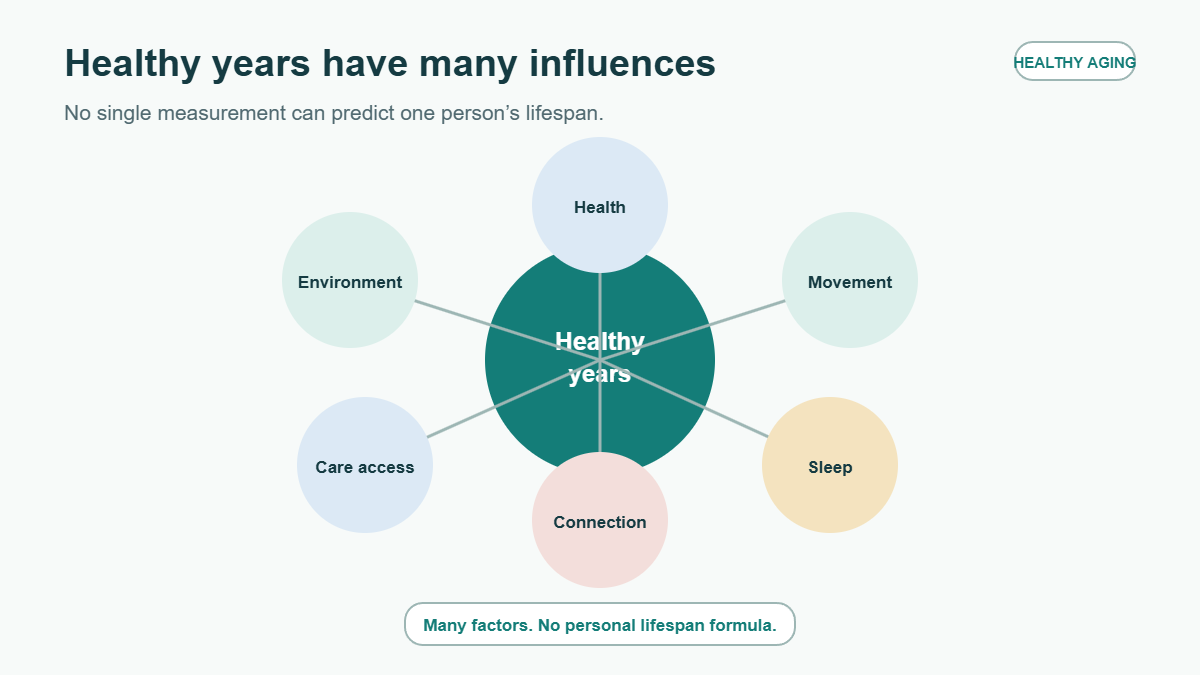
Health and aging reflect many influences over time, including medical conditions, family history, environment, daily habits, relationships, and access to care. Their effects are not identical for everyone, and a population statistic cannot tell an individual exactly what will happen. Weight may be one part of a wider health discussion, but it is not a personal countdown.
Focus on questions you can act on
Instead of asking an online tool to predict a lifespan, consider what health concern you want help with now: a symptom, a screening question, sleep, movement, medication, or support with a habit. A healthcare professional can discuss steps that fit your circumstances and priorities. Small changes may support health, but no calculator can promise a particular outcome.
Our weight-management guide offers general information and is not a life-expectancy assessment.
Common questions
Can a longevity calculator predict my lifespan?
No calculator can determine an individual lifespan from weight alone. Estimates are uncertain and depend on many factors.
Does weight matter for health?
It can be one part of a broader conversation, but it should not be used by itself to predict how long someone will live.
What is a more useful next step?
Discuss specific health goals or symptoms with a clinician who understands your medical history.
Sources
Educational information only; not a lifespan estimate or personalized medical advice.

