 Skip to content
Macros are carbohydrate, protein, and fat, the main nutrients that provide energy in food. Tracking them is one way of describing intake, not a requirement for weight loss. A percentage split can help organize information, but it does not prove that the total intake or food pattern is appropriate.
Translate percentages into grams carefully
For ordinary macro calculations, carbohydrate and protein are commonly counted as about 4 kcal per gram and fat as about 9 kcal per gram. This is planning arithmetic; food-label rounding and details such as fibre can mean totals do not match perfectly.
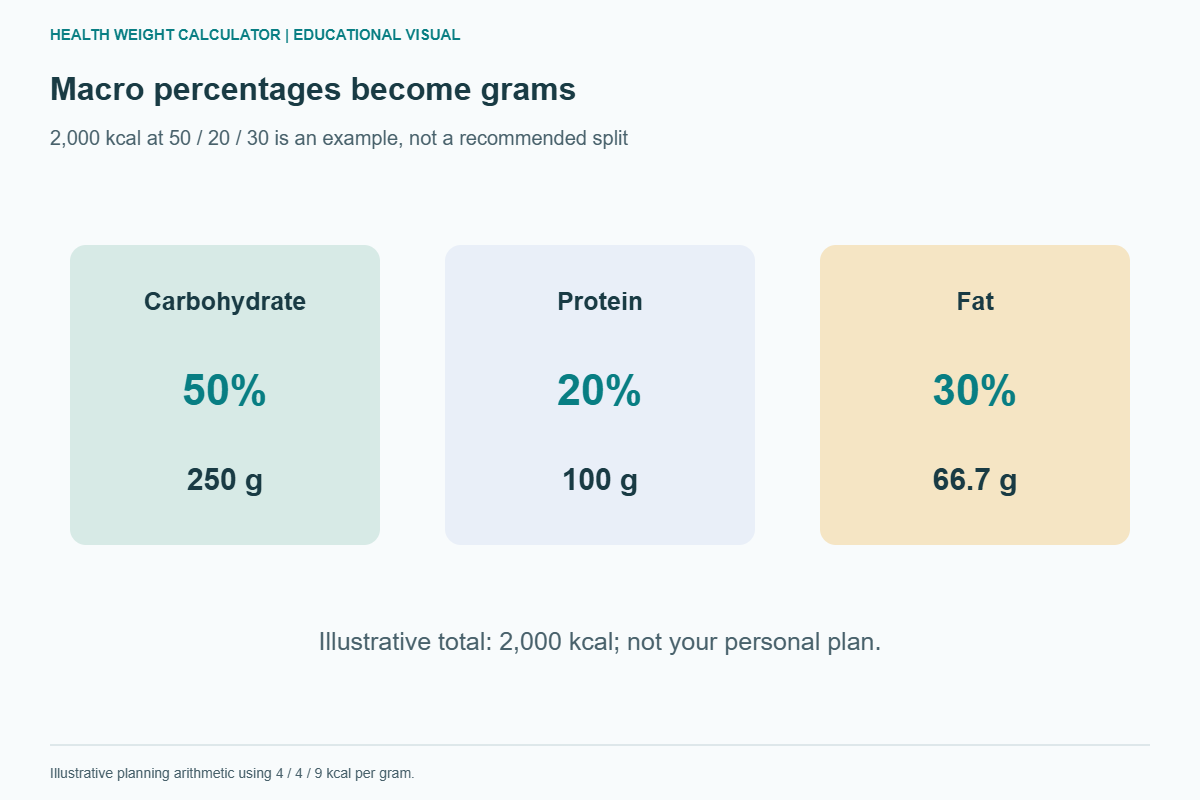
Consider an illustrative 2,000-kcal plan with 50% carbohydrate, 20% protein, and 30% fat. The calculation gives 1,000 ÷ 4 = 250 g carbohydrate, 400 ÷ 4 = 100 g protein, and 600 ÷ 9 = about 66.7 g fat. These values demonstrate the method only. They are not a recommended calorie total or split for you.
Check the foundation before adjusting the split
A macro plan starts with an energy estimate. If that estimate does not fit your needs, changing percentages will not fix inadequate intake. Work, routine movement, exercise, age, health, and life stage all matter.
Dietary reference values are designed for particular populations and purposes, as NIH’s Office of Dietary Supplements explains. A fitness app’s default is not an individualized assessment. Medical nutrition care may require a different approach.
Make room for food quality and enjoyment
Foods contain mixtures of nutrients. Lentils are not only carbohydrate; nuts are not only fat. A meal can fit your preferred foods and culture without separating everything into perfect columns.
Macro totals also miss important detail: fibre, vitamins, minerals, food access, cooking practicality, and whether meals are satisfying. NIDDK recommends a varied eating pattern that can be maintained over time. Do not remove fruit, grains, or other food groups solely to make an app display a better score.
When not to use generic targets
Pregnancy, breastfeeding, growth, kidney disease, diabetes treatment, and eating-disorder concerns need individualized advice. Do not change medicine or start an extreme split from a calculator. If tracking becomes distressing or compulsive, a non-tracking approach with support may be better.
See our BMR guide for the distinction between resting and daily energy needs and our meal-planning and calorie-estimate guide for label interpretation.
Questions readers ask
Must I hit every gram precisely?
No. The inputs and labels are estimates, and day-to-day eating need not be identical.
Can a macro split diagnose a deficiency?
No. Nutritional assessment may require history and appropriate tests.
Sources
General adult education; numerical example is not an individualized prescription.
Short visual recap
Visual recap transcript
Macros are carbohydrate, protein, and fat, the main nutrients that provide energy in food. Tracking them is one way of describing intake, not a requirement for weight loss. A percentage split can help organize information, but it does not prove that the total intake or food pattern is appropriate.
Macro percentages become grams. Illustrative 2000 kcal split: carbohydrate 250 g, protein 100 g, fat about 66.7 g.
No. The inputs and labels are estimates, and day-to-day eating need not be identical.
