 Skip to content
No daily step number guarantees weight loss. Step counts can help describe movement, but they do not capture everything about effort, food intake, health, or energy use. A fixed target such as 10,000 is not a requirement that every person must meet before activity counts.
Find a realistic baseline
If a tracker is useful for you, observe several ordinary days before setting a goal. Include working days and days off. Compare readings from the same device, because phones, watches, and other trackers may count differently.
Then consider a manageable change: a short walking break, a slightly longer route, or movement during a usual sedentary period. The size of an appropriate increase depends on your abilities and health. You do not need to turn an unusually active holiday day into your everyday target.
Steps and intensity answer different questions
A step count does not reveal whether you were strolling, climbing a hill, or walking briskly. CDC describes moderate effort using the talk test: talking is possible, but singing is difficult. That can help interpret effort without requiring a particular speed.
The general adult guidelines use activity time and intensity, plus strength work, rather than a universal step quota. Non-step activities such as cycling, swimming, and some adapted exercise can also be worthwhile.
Protect comfort and recovery
- Choose safe routes, suitable footwear, and weather-appropriate conditions.
- Build gradually rather than making a large jump to satisfy a device.
- Break walking into shorter opportunities if that is more practical.
- Use an adapted activity if walking aggravates pain or balance problems.
Ask a healthcare professional for advice if a condition or injury limits activity. Do not push through chest pain, faintness, or unusual severe breathlessness to finish a step streak.
Why weight may not match the step trend
Weight is affected by intake, water changes, medicines, illness, and other circumstances. More movement does not translate into an exact number of kilograms lost. NIDDK emphasizes that activity offers important health benefits even when weight does not change.
If the tracker is making you anxious or driving compensatory exercise, use another approach. Comfortable distance, time outside, or improved daily function may be better measures.
Read our workout-calorie article before treating device calories as exact. The BMR guide explains why resting needs are only part of daily expenditure.
Questions readers ask
Do short walks count?
Yes. Activity can be accumulated in smaller periods.
Is a missed target a reason to double tomorrow?
No. Resume a manageable routine instead of compensating.
Sources
- CDC: Adult Activity Recommendations
- CDC: Relative Intensity and Talk Test
- NIDDK: Benefits Beyond Weight Change
General adult activity information, not a personal step prescription.
Short visual recap
Visual recap transcript
No daily step number guarantees weight loss. Step counts can help describe movement, but they do not capture everything about effort, food intake, health, or energy use. A fixed target such as 10,000 is not a requirement that every person must meet before activity counts.
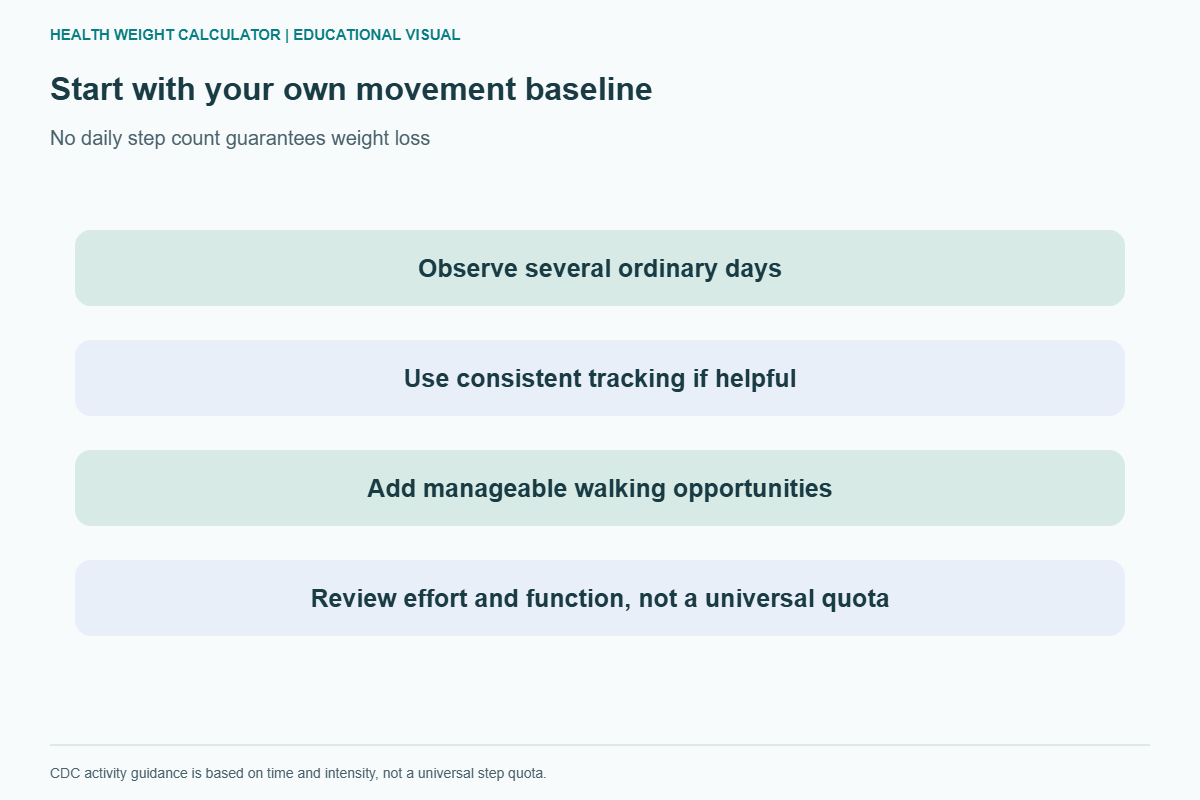
Start with your own movement baseline. Observe several ordinary days. Use consistent tracking if helpful. Add manageable walking opportunities. Review effort and function, not a universal quota.
Yes. Activity can be accumulated in smaller periods.
