 Skip to content
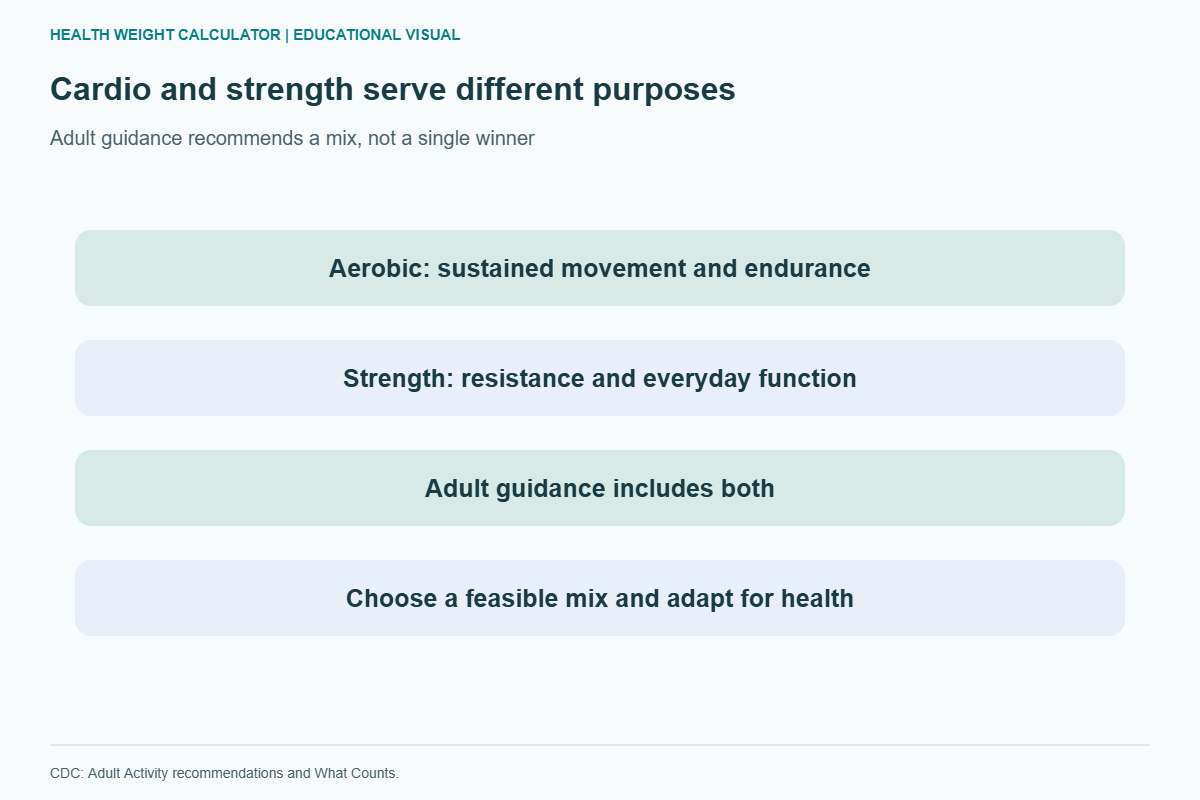
Cardio and strength training do different jobs, so weight management does not have to be a contest between them. Aerobic activity raises breathing and heart rate; strengthening challenges muscles against resistance. Adult activity guidance recommends both rather than declaring one universally best.
What each approach contributes
| Activity type | Examples | Useful focus |
|---|---|---|
| Aerobic | Brisk walking, cycling, swimming | Endurance and comfortable sustained movement |
| Strengthening | Weights, bands, suitable body-weight exercises | Muscle strength and everyday tasks |
A single workout-calorie number misses these differences. A strength session with rest periods is not easily compared with continuous walking simply by duration. Device estimates add another layer of uncertainty.
Use the adult guidelines as context
CDC recommends at least 150 minutes of moderate-intensity aerobic activity weekly, 75 minutes vigorous, or an equivalent mix, plus strengthening on at least two days. Major muscle groups should be included. This is general health guidance, not a prescription to start at that amount or a promise of a particular weight change.
If you are new to exercise, begin with manageable amounts. Some activity is better than none. A health condition, injury, balance difficulty, or other limitation may call for adapted advice.
Build a week around what is feasible
An illustrative routine could place comfortable aerobic activity on several days and strength sessions on two days, allowing recovery between demanding work for the same muscles. The exact days, duration, resistance, and exercises should fit the person.
If you only have a little time, avoid the all-or-nothing trap. Start with one feasible activity and gradually add another element. Enjoyment, access, cost, and safety influence consistency more than a theoretical winner you dislike.
Why the scale is not the whole result
Weight can change slowly or fluctuate even when function improves. Notice easier stairs, better exercise tolerance, or progress with a familiar resistance. Neither a body-composition device nor a short-term weight trend fully describes training effects.
Food, sleep, medicines, and health also affect weight. Do not use training to punish meals or assume a harder session permits unsafe restriction afterward. Our workout-calorie guide discusses energy estimates, and the muscle-mass article explains measurement limitations.
Questions readers ask
Can I do both on the same day?
Some people do, but appropriate scheduling depends on goals, recovery, and ability.
Must I lift heavy weights?
No universal load fits everyone. Learn technique and choose suitable resistance.
Sources
General adult education, not an individualized training programme.
Short visual recap
Visual recap transcript
Cardio and strength training do different jobs, so weight management does not have to be a contest between them. Aerobic activity raises breathing and heart rate; strengthening challenges muscles against resistance. Adult activity guidance recommends both rather than declaring one universally best.
Cardio and strength serve different purposes. Aerobic: sustained movement and endurance. Strength: resistance and everyday function. Adult guidance includes both. Choose a feasible mix and adapt for health.
Some people do, but appropriate scheduling depends on goals, recovery, and ability.
