 Skip to content
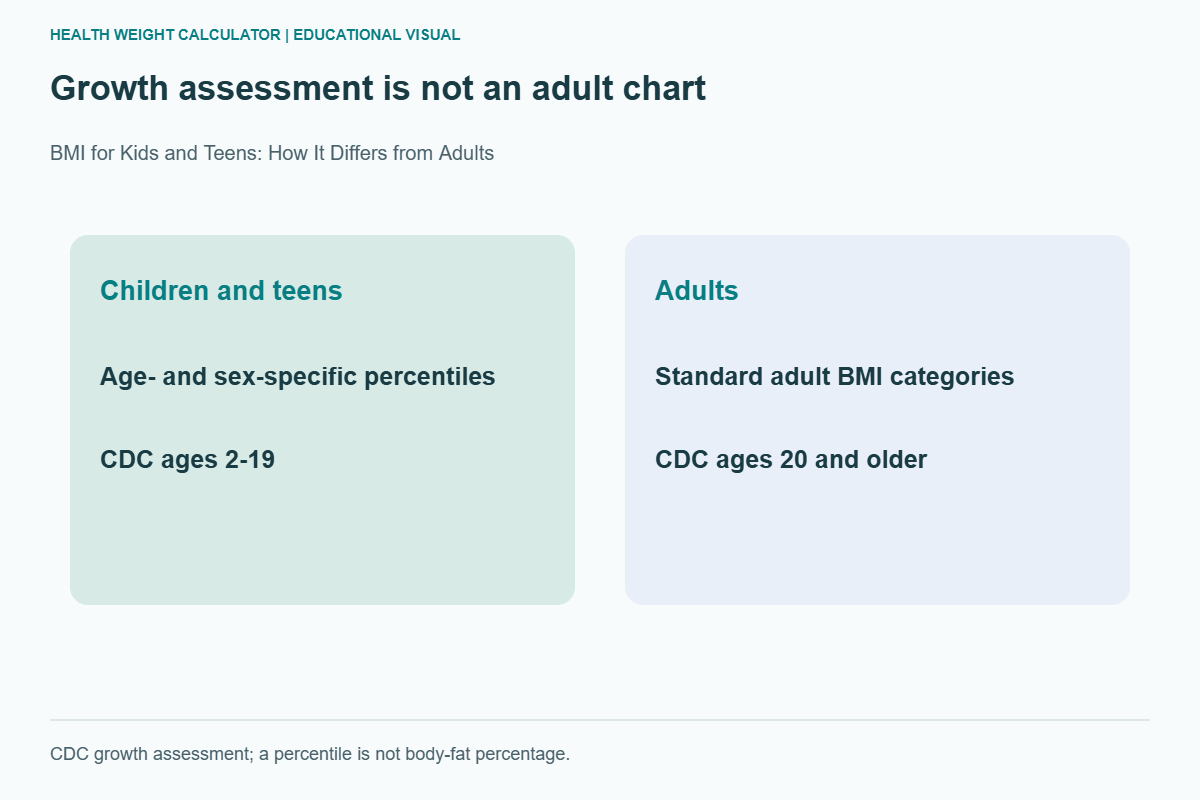
BMI for children and teenagers must be interpreted using age- and sex-specific growth references, not adult BMI cutoffs. The calculation still uses weight relative to height, but its meaning changes as a child grows. A pediatric professional should interpret the result alongside growth history and development.
Why the adult chart does not fit
Children’s body proportions and body composition change with age and puberty. A BMI that means one thing at age eight may mean something different at sixteen. Growth charts compare the measurement with an appropriate reference group rather than assigning the adult 18.5-to-less-than-25 interval.
CDC child and teen assessment covers ages 2 through 19. Accurate age, the sex used by the growth reference, measured height, and measured weight are needed. When standard references do not fit a young person’s circumstances, a clinician can explain appropriate interpretation rather than relying on an automated label.
Understand the growth pattern
A percentile describes position within a reference distribution; it is not a percentage of body fat and not a grade. Clinicians consider repeated measurements, growth velocity, puberty, family history, medicines, and health conditions. One unusual measurement may need checking before it is interpreted as a trend.
Support wellbeing without prescribing restriction
- Offer regular, adequate meals and enjoyable movement suited to the child’s needs.
- Make changes as a household rather than singling out one child’s body.
- Focus on sleep, function, confidence, and access to nutritious food.
- Avoid adult calorie-deficit targets, fasting schedules, or weight-loss deadlines.
Seek assessment for unexplained growth changes, fatigue, dizziness, distress around food, or bullying. A young person does not need to reach a particular percentile before deserving help.
Parent and teen questions
Should a child aim for the 50th percentile?
No. The middle of a chart is not a universal individual goal.
Can an adult weight-loss calculator be adjusted for a teenager?
Simply changing the age does not make it appropriate. Pediatric assessment needs growth-aware guidance rather than a fixed adult deficit.
Sources and further reading
- CDC: Adult BMI Categories
- CDC: About BMI
- CDC: Child and Teen BMI Calculator
- NIDDK: Assessing Weight and Health
Related reading: child BMI percentiles and growth assessment. Educational information, not a diagnosis or a personalized treatment plan.
Short visual recap
Visual recap transcript
BMI for children and teenagers must be interpreted using age- and sex-specific growth references, not adult BMI cutoffs. The calculation still uses weight relative to height, but its meaning changes as a child grows. A pediatric professional should interpret the result alongside growth history and development.
Growth assessment is not an adult chart. Children and teens|Age- and sex-specific percentiles|CDC ages 2-19; Adults|Standard adult BMI categories|CDC ages 20 and older. CDC growth assessment; a percentile is not body-fat percentage.
No. The middle of a chart is not a universal individual goal.
