 Skip to content
If you have seen waist-to-height ratio mentioned as a health check, the calculation is simple—but the number is only a screening clue. It compares waist circumference with height. It cannot diagnose a condition, directly measure internal body fat, or tell the whole story about your health.
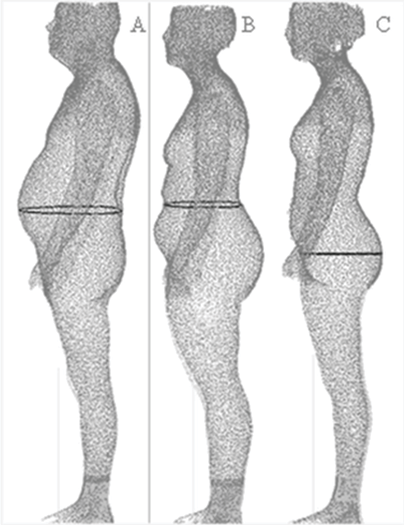
How to calculate waist-to-height ratio
Use this formula:
Waist-to-height ratio = waist circumference ÷ height
Measure waist and height in the same units. For example, an illustrative waist measurement of 82 cm divided by a height of 170 cm is 82 ÷ 170 = 0.482, usually rounded to 0.48. The example only shows the arithmetic; it is not a health assessment for any individual. If measurements are in inches, use inches for both values.
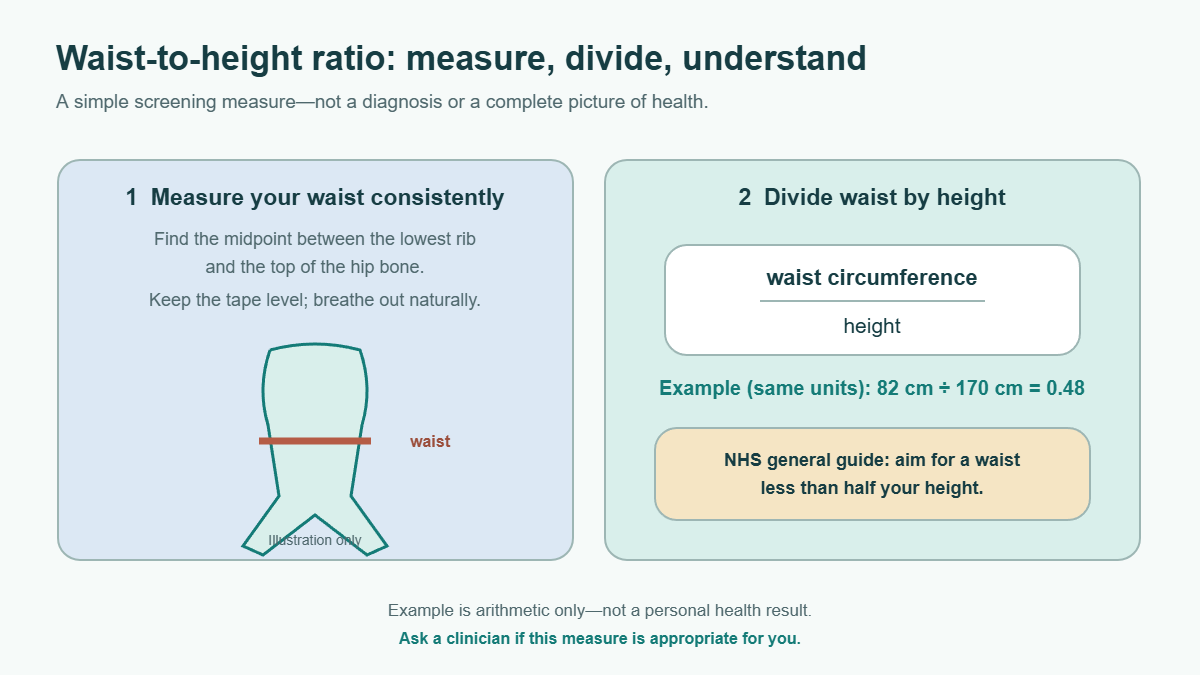
How to measure your waist
A small difference in where you place the tape can change the result, so measure carefully:
- On your side, feel for the lowest rib and the top of your hip bone.
- Find the midpoint between them; it is roughly level with the belly button.
- Wrap a flexible tape around that point, keeping it level and comfortably snug—not pulled tight.
- Breathe out naturally. Do not hold your breath or pull your stomach in while reading the measurement.
These are the NHS waist-measurement instructions. If you are tracking measurements, use the same method each time rather than comparing readings taken at different points on your body.
What does the ratio mean?
The NHS offers a simple general message: try to keep your waist measurement to less than half your height. Put another way, a ratio below 0.5 means the waist measurement is less than half of the height when both are measured in the same units. A result at or above 0.5 is not a diagnosis and does not establish that someone has a health problem. It can be a reason to consider the number alongside other information or ask a healthcare professional what it means for you.
Waist-to-height ratio is one way to describe central body size. It does not directly show how much fat is present, identify where all body fat is located, or determine blood pressure, cholesterol, blood glucose, or disease risk on its own. The National Institute of Diabetes and Digestive and Kidney Diseases explains that carrying more fat around the waist can be relevant to health, while the CDC explains the limits of BMI as another screening measure. Neither measurement replaces a full assessment.
Who should use this measure cautiously?
The NHS says its waist-to-height calculator is not for children under 5, people who are pregnant, people with a growth disorder or another condition affecting height, or people with a diagnosed or suspected eating disorder. It also says adults with a BMI over 35 should not use that calculator. For people aged 17 or younger, it recommends using the tool with a parent or carer. These are NHS tool instructions; if you are unsure whether a measurement is appropriate for you, ask a healthcare professional.
Numbers can be stressful, especially if you have a difficult relationship with food or body image. You do not need to use a calculator that makes you feel worse. A clinician can discuss health concerns without reducing you to a measurement.
Common questions
Can I mix centimetres and inches?
No. Use the same unit for waist and height. The units cancel in the division, leaving a ratio with no unit.
Is waist-to-height ratio the same as waist-to-hip ratio?
No. Waist-to-height compares waist with height. Waist-to-hip compares waist with hip circumference; they are different calculations.
Does a ratio tell me whether I have a disease?
No. It is a screening measure, not a diagnosis or a substitute for clinical measurements and tests.
Where can I find trustworthy measurement guidance?
Read the NHS calculator guidance and its waist-measurement instructions. Our calculator collection and weight-management information are educational and cannot diagnose or predict an individual’s health.
Sources
- NHS: Calculate your waist-to-height ratio
- NHS: How to measure your waist
- NIDDK: Health risks of overweight and obesity
- CDC: About BMI and its limitations
- Medina-Inojosa et al. (2016): 3D body-scanner anthropometric measurements
Educational information only. Waist-to-height ratio is not a diagnosis or individualized medical advice.

Pingback: Hamwi Formula Weight Calculator: What the Estimate Means
Pingback: Pediatric Growth BMI Calculator: Use Age-Specific Charts
Pingback: Waist-to-Hip Ratio and Health: What a Screening Number Means
Pingback: BMI Prime Calculator: A Ratio, Not a Diagnosis
Pingback: Weight and Fertility: Why a Calculator Cannot Predict Pregnancy
Pingback: Erectile Dysfunction and Weight: Why a Calculator Cannot Diagnose ED
Pingback: Somatotype Calculator: What Body-Type Labels Mean
Pingback: Best Foods to Lose Belly Fat? Start with the Claim
Pingback: Waist-to-Hip Ratio and Health Risks: Interpret the Ratio Carefully
Pingback: Healthy BMI Range for Women by Age: What Changes?