 Skip to content
A micronutrient calculator estimates vitamin and mineral intake from recorded foods and supplements. It does not diagnose a deficiency from one day’s menu. Food composition, quantities, preparation, absorption, and individual health all influence interpretation.
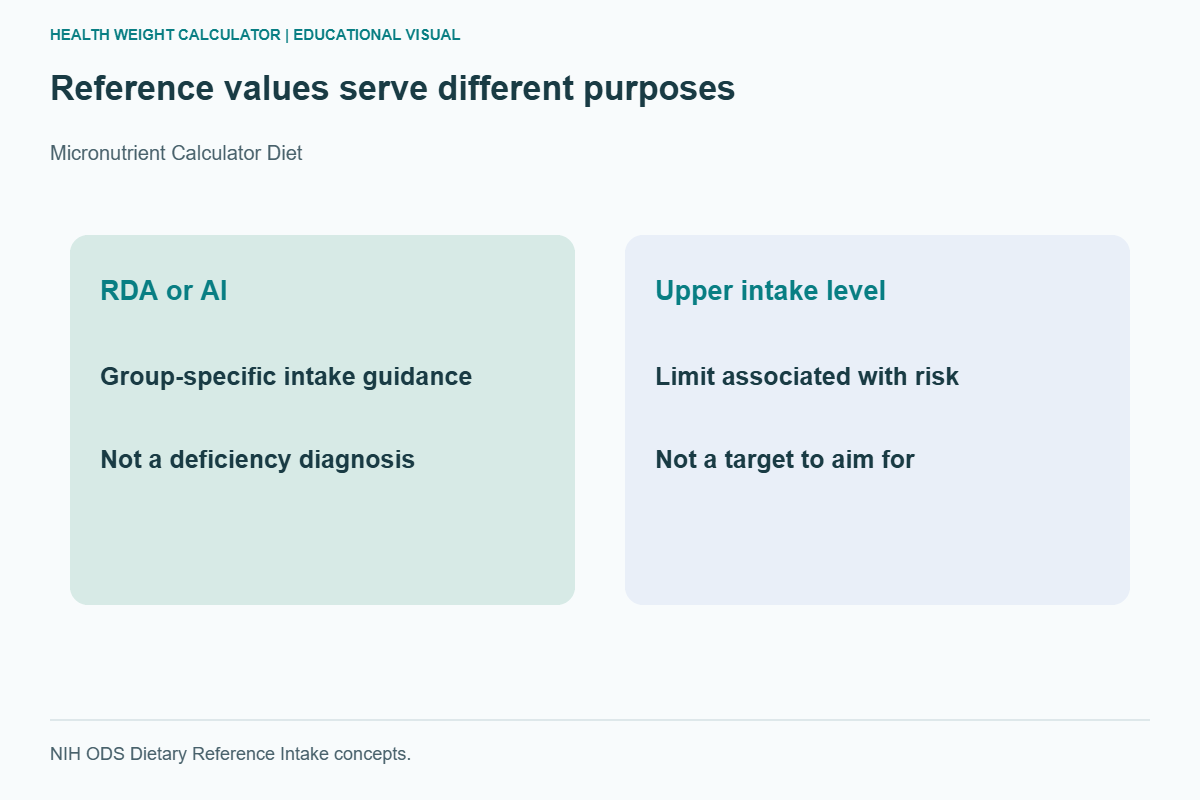
Use the right reference
NIH explains several Dietary Reference Intake terms. An RDA is designed to meet the needs of nearly all healthy people in a specified group. An AI is used when evidence is insufficient to set an RDA. A tolerable upper intake level is not a target to aim for.
Age, life stage, and the nutrient’s units matter. Milligrams and micrograms differ by a factor of 1,000. Some nutrients have form-specific units, so a tool must not combine incompatible values without an appropriate conversion.
Improve the food record
- Select the correct food, preparation method, and actual amount.
- Include fortified foods and supplements without double-counting them.
- Record several reasonably representative days when appropriate.
- Recognize missing database values rather than treating them as zero.
For example, one recorded day below a reference does not prove a clinical deficiency. Equally, a calculated adequate total does not rule out an absorption problem.
When professional interpretation helps
Restricted diets, pregnancy, older age, digestive conditions, medicines, and symptoms may require individual assessment. Blood tests are useful for selected questions but are not interchangeable with a food diary.
Questions
Should I add supplements for every low number?
No. Check the record, usual pattern, appropriate reference, interactions, and potential excess with a qualified professional.
Is 100% of a label Daily Value my exact need?
No. Label references support general comparison, not individualized requirements.
Sources and further reading
- NIH ODS: Dietary Reference Intakes and Nutrient Recommendations
- FDA: Understanding the Nutrition Facts Label
- NIDDK: Eating and Physical Activity
Related reading: nutrient deficiency assessment limitations. Educational information, not a diagnosis or personalized nutrition prescription.
Short visual recap
Visual recap transcript
A micronutrient calculator estimates vitamin and mineral intake from recorded foods and supplements. It does not diagnose a deficiency from one day’s menu. Food composition, quantities, preparation, absorption, and individual health all influence interpretation.
Reference values serve different purposes. RDA or AI|Group-specific intake guidance|Not a deficiency diagnosis; Upper intake level|Limit associated with risk|Not a target to aim for. NIH ODS Dietary Reference Intake concepts.
No. Check the record, usual pattern, appropriate reference, interactions, and potential excess with a qualified professional.
