 Skip to content
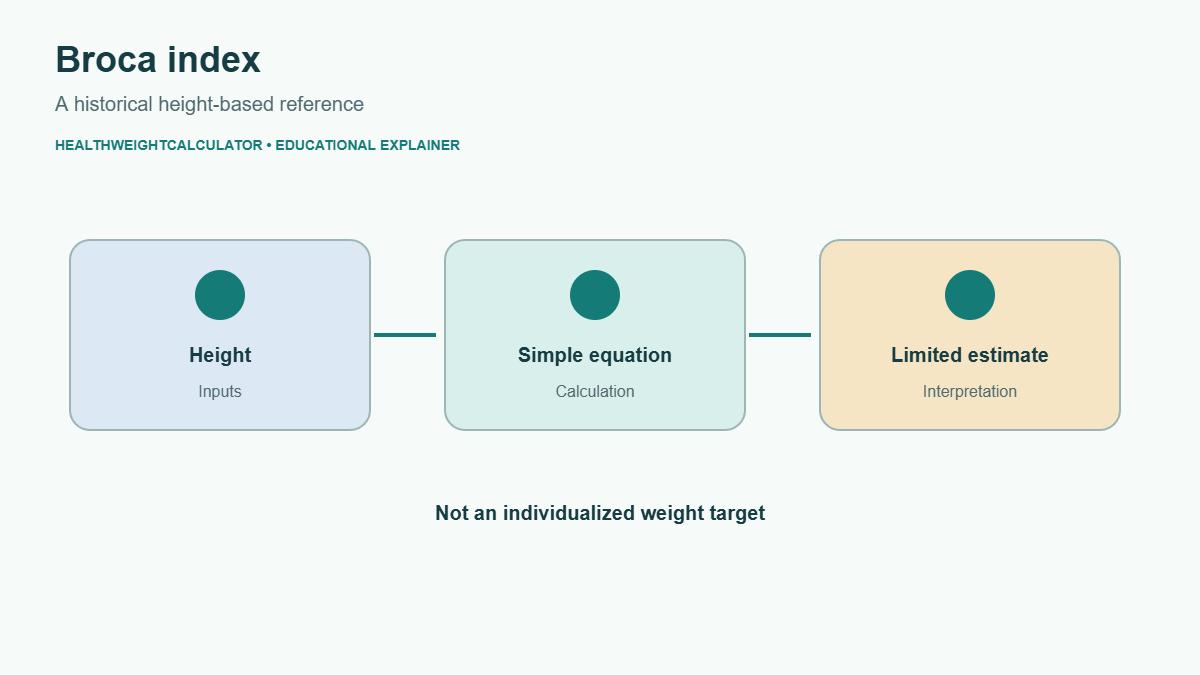
The Broca index is a historical height-based approach to estimating a reference weight. A simplified version often subtracts 100 from height in centimetres to produce a value in kilograms. Other versions add adjustments, so calculators may not agree. The equation is easy to remember, but that simplicity should not be mistaken for individual accuracy.
Why versions and outputs differ
Some tools present the basic height-minus-100 calculation; others modify it by sex, build, or another factor. A result also depends on the units and rounding rules. Before comparing values, read the calculator’s method. None of these variations turns the equation into a direct measurement of body composition or a medical evaluation.
Use the result cautiously
A height-only estimate cannot account for muscle, age, health history, or many other factors that can matter when discussing weight. The CDC explains that BMI is a screening measure and does not distinguish fat, muscle, and bone. A simple formula like the Broca index should be interpreted at least as cautiously, not used as a diagnosis or prescription.
Do not use the index to set a restrictive diet or determine whether a person is healthy. If you are considering a weight goal or have concerns about weight change, consult a healthcare professional who can discuss your situation. Other ideal-weight equations also vary: see our Hamwi formula explanation and Devine formula guide.
Common questions
What is the basic Broca calculation?
A simplified version subtracts 100 from height in centimetres to estimate kilograms; variants exist.
Is the result an ideal weight?
No. It is not a personalized clinical recommendation.
Can it measure body fat?
No. It uses height and does not directly measure body composition.
Sources
Educational information only; not a diagnosis or personal weight goal.
