 Skip to content
Calories burned running are estimated from factors including body size, duration, pace, incline, and the calculation method. They are not a direct measurement of weight loss. Running can support fitness even when a session does not produce a visible scale change.
Get time, speed, and distance straight
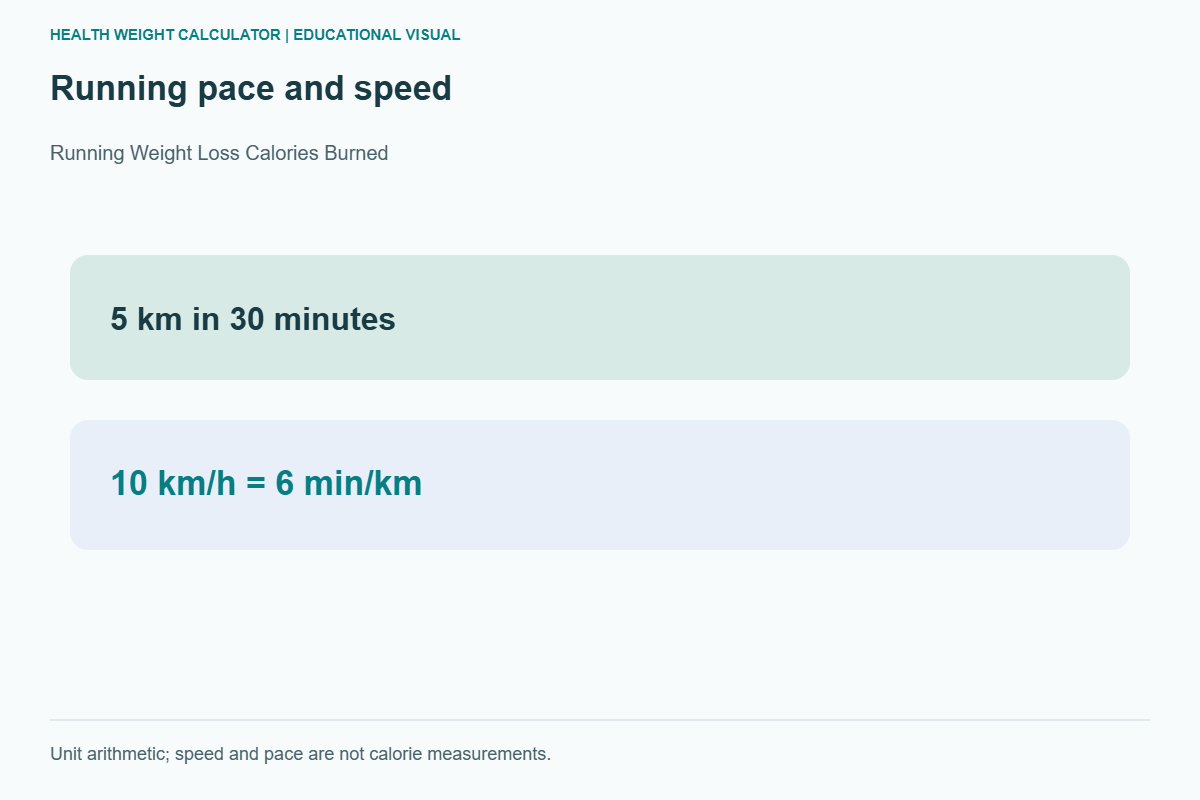
A 5 km run in 30 minutes has an average speed of 10 km/h and a pace of 6 minutes per kilometre. Neither number is itself a calorie count. Entering minutes per kilometre into a kilometres-per-hour field creates a different estimate.
Read the energy definition
Some tools report gross calories, including energy you would use at rest during the session. Others report active calories above rest. Device estimates vary, and treadmill incline or support from handrails can affect the real demand.
If a daily expenditure calculation already includes running, adding the full session estimate again can double-count activity. A static conversion from those calories into pounds or kilograms also ignores adaptation, fluid changes, and changes elsewhere in the day.
Use the result without letting it run the plan
- Record the route, duration, effort, and recovery.
- Build training gradually from your current ability.
- Eat adequately for activity and recovery rather than treating food as a reward to earn.
- Adapt for pain, illness, heat, and medical guidance.
Questions
Is faster always better for weight management?
No. Suitability, total routine, recovery, and consistency matter more than maximizing one session’s number.
Why does my watch disagree with the treadmill?
They use different inputs and models. Neither disagreement proves that one result is exact.
Sources and further reading
- NIDDK: Factors Affecting Weight and Health
- CDC: Measuring Physical Activity Intensity
- Maintenance of Lost Weight and Long-Term Management of Obesity (2018 review)
Related reading: daily calorie needs and estimate limitations. Educational information, not an individualized treatment or exercise plan.
Short visual recap
Visual recap transcript
Calories burned running are estimated from factors including body size, duration, pace, incline, and the calculation method. They are not a direct measurement of weight loss. Running can support fitness even when a session does not produce a visible scale change.
Running pace and speed. 5 km in 30 minutes; 10 km/h = 6 min/km. Unit arithmetic; speed and pace are not calorie measurements.
No. Suitability, total routine, recovery, and consistency matter more than maximizing one session’s number.
