 Skip to content
BMI and body-fat percentage answer different questions. BMI describes weight relative to height. Body-fat percentage estimates the proportion of body mass that is fat. Neither measurement alone tells you whether you are healthy, and a more detailed-looking number is not necessarily more accurate.
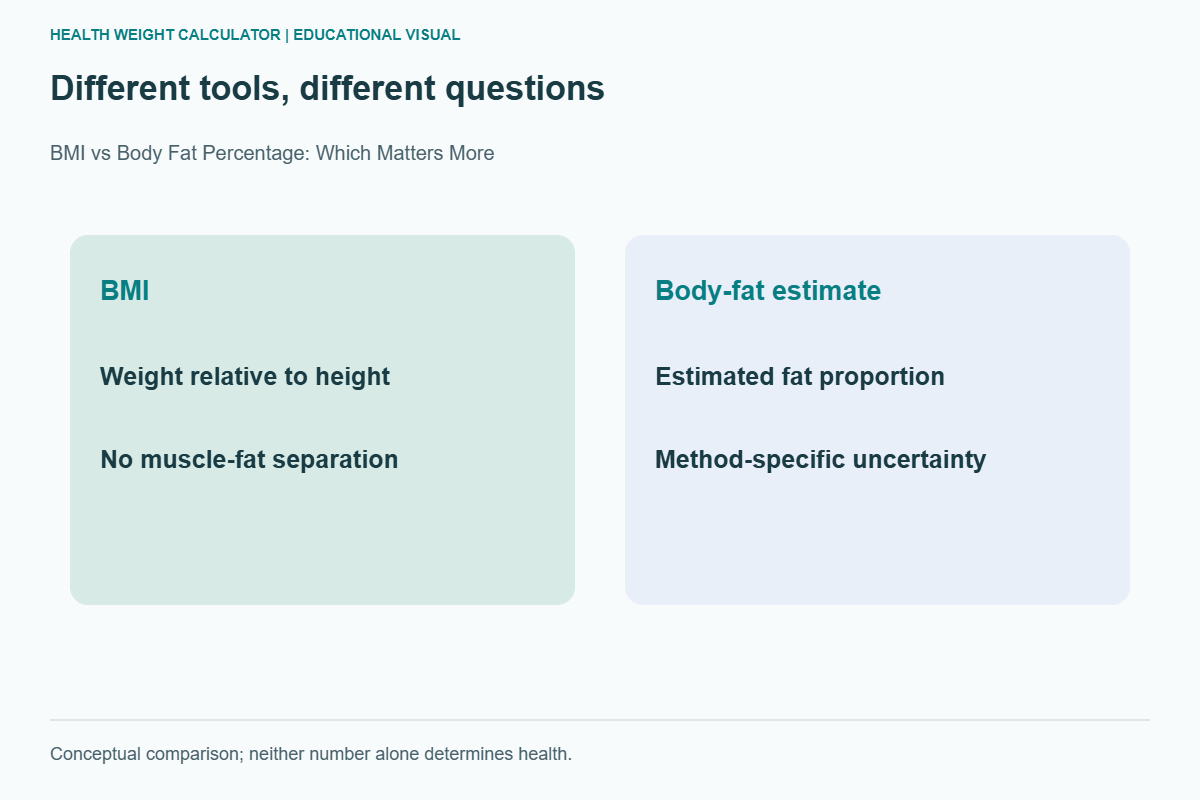
What each measure can show
| Measure | Useful feature | Main limitation |
|---|---|---|
| BMI | Simple, inexpensive screening | Does not separate muscle and fat |
| Home body-fat scale | Convenient repeated estimates | Hydration and device equations affect results |
| Skinfold estimate | Uses measured skinfold thickness | Technique and prediction equation matter |
| Clinical body-composition assessment | More detailed information when indicated | Cost, access, and method-specific uncertainty |
A useful comparison
Two adults can share a BMI while having different proportions of muscle and fat. Equally, a home device can report a body-fat change after hydration shifts without a corresponding change in fat tissue. Do not interpret every decimal as a biological discovery.
Estimated fat mass equals body weight multiplied by estimated body-fat fraction. At 80 kg and an estimated 25%, that is 20 kg of estimated fat mass. The calculation inherits the uncertainty of the 25% estimate; it does not make the measurement exact.
Choose a measure for the decision
For a routine health review, measured weight, height, waist, blood pressure, relevant tests, and symptoms may be more helpful together than an expensive device. For sports or rehabilitation questions, a qualified professional can explain whether body-composition testing would change the plan.
If you track a home measure, use the same device under comparable conditions and look at longer trends. Avoid comparing percentages from unrelated devices or methods as if they were interchangeable.
Frequently asked questions
Does a low body-fat number guarantee fitness?
No. Strength, endurance, adequate nutrition, and medical health are separate considerations.
Which number matters more?
The one that helps answer a real clinical or functional question, interpreted with its limitations. Neither should become a standalone personal score.
Sources and further reading
Related reading: adult BMI chart and interpretation. Educational information, not a diagnosis or a personalized treatment plan.
Short visual recap
Visual recap transcript
BMI and body-fat percentage answer different questions. BMI describes weight relative to height. Body-fat percentage estimates the proportion of body mass that is fat. Neither measurement alone tells you whether you are healthy, and a more detailed-looking number is not necessarily more accurate.
Different tools, different questions. BMI|Weight relative to height|No muscle-fat separation; Body-fat estimate|Estimated fat proportion|Method-specific uncertainty. Conceptual comparison; neither number alone determines health.
No. Strength, endurance, adequate nutrition, and medical health are separate considerations.
