 Skip to content
An adult BMI chart can make category labels easier to understand, but it cannot tell the whole story about one person’s health. The calculation uses height and weight and is best read alongside other information.
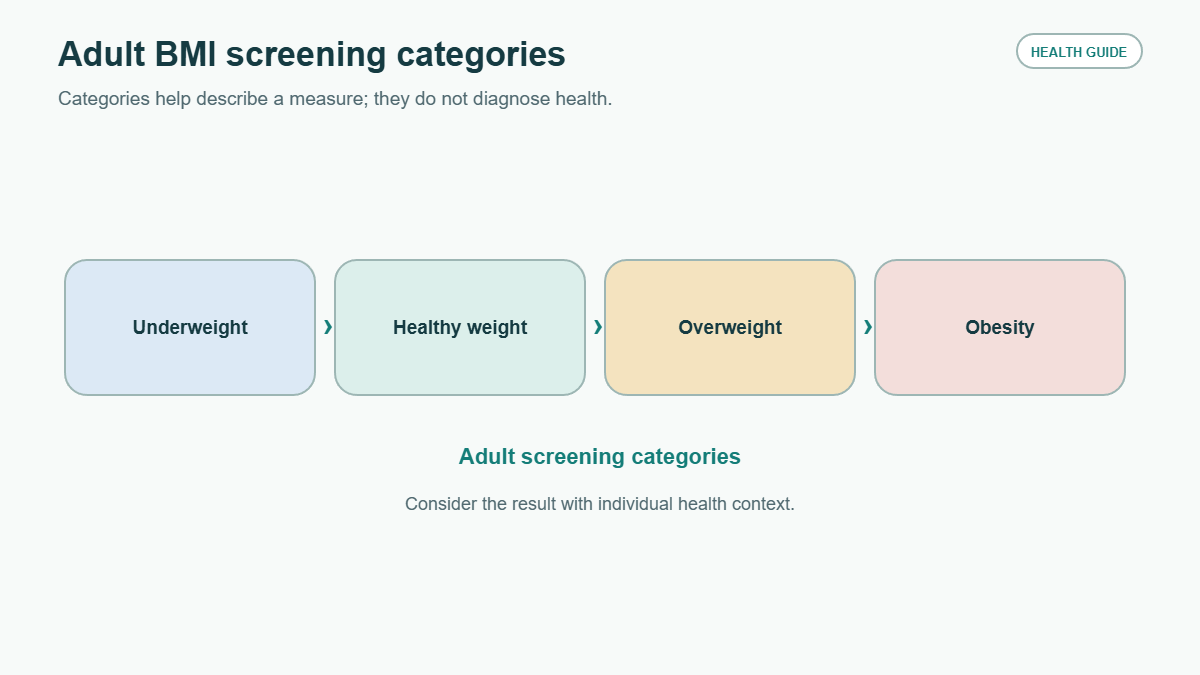
Standard adult BMI categories
For adults, the commonly used categories are: below 18.5, underweight; 18.5 to less than 25, healthy weight; 25 to less than 30, overweight; and 30 or higher, obesity. The obesity category is often divided into classes: class 1 from 30 to less than 35, class 2 from 35 to less than 40, and class 3 at 40 or higher. These are standard adult screening ranges used by the CDC; they are not a complete assessment of an individual.
BMI is calculated as weight in kilograms divided by height in metres squared. The CDC’s adult BMI calculator is intended for adults 20 and older. Children and teens require BMI-for-age percentiles rather than the adult chart. The CDC BMI overview explains the formula and its limitations.
How to read a chart responsibly
First, check that the calculator uses the correct units and that the measurement is current. Next, note the category without treating it as a diagnosis. Finally, consider whether you need a conversation with a health professional. The CDC says BMI should be considered with other factors, which may include medical history, health behaviors, physical examination, and laboratory findings.
A chart cannot show how much of a person’s weight is muscle, fat, or bone, or where fat is distributed. It does not account for every difference in age, body composition, or health background. Some public-health guidance uses additional or adjusted risk thresholds for particular populations; ask a clinician which reference is appropriate for you.
Our healthy weight guide and calculator collection offer further general information. They should not be used to set a treatment plan or make decisions about medication.
Short video: how to read an adult BMI result
Frequently asked questions
Does an adult BMI category diagnose obesity or another condition?
No. It is a screening category based on height and weight. A clinician considers other information before making an individual assessment.
Can I use an adult BMI chart for a teenager?
No. Children and teens are assessed using BMI-for-age references that account for age and sex. Use an appropriate pediatric tool and ask a clinician about results.
Does the chart account for muscle?
No. BMI does not separate muscle from fat or bone. People with a higher amount of muscle may need a broader assessment.
Sources
This article is educational and does not provide a diagnosis or personalized medical advice.

Pingback: What Is a Healthy BMI for Adults | Health Weight Calculator
Pingback: How to Lower Your BMI: Practical Steps | Health Weight Calculator
Pingback: Normal BMI Range for Women: What You Should Know | Health Weight Calculator
Pingback: How to Measure Body Fat at Home Accurately | Health Weight Calculator
Pingback: Overweight BMI: Health Risks and What to Do | Health Weight Calculator