 Skip to content
A healthy BMI for adults is a screening category, not a medical verdict or an instruction to reach a particular weight. CDC categories for adults aged 20 and older describe BMI from 18.5 to less than 25 as the healthy-weight range. Your medical history, body composition, waist measurement, and physical function add information the number cannot supply.
Calculate BMI with consistent units
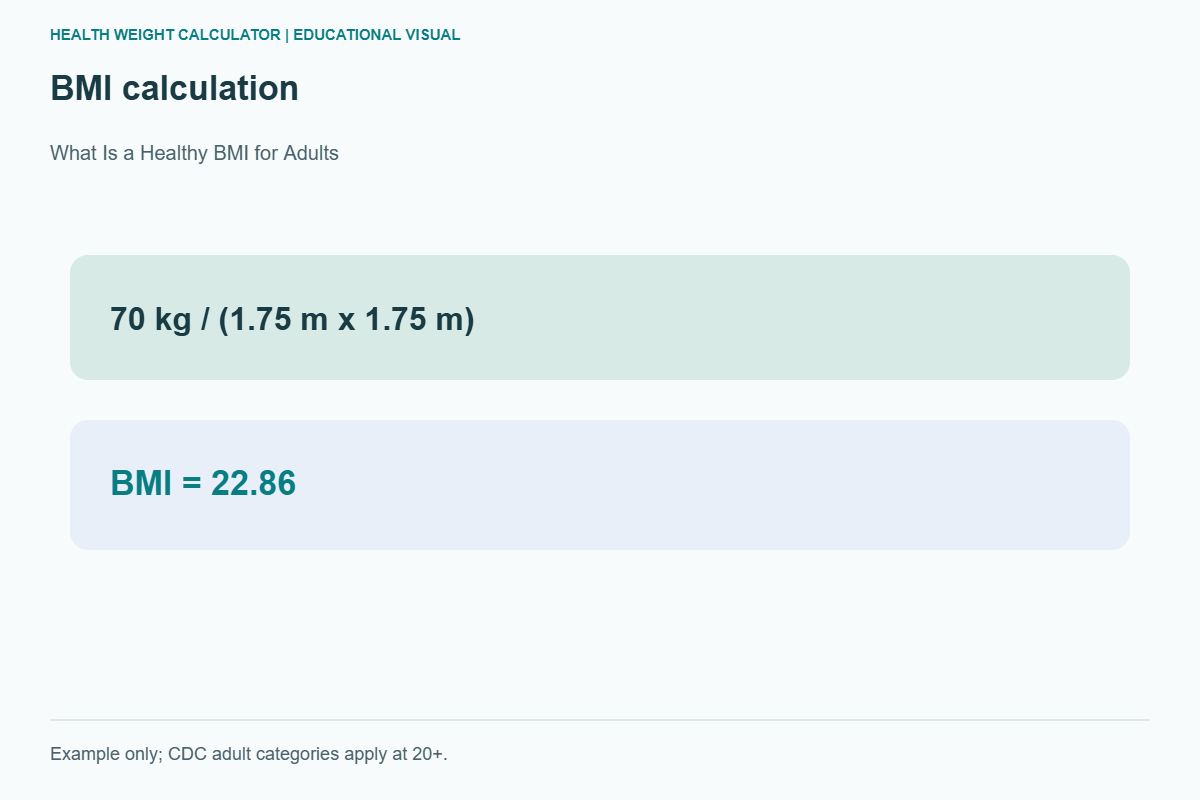
Divide weight in kilograms by height in metres squared. At 70 kg and 1.75 m, the calculation is 70 / (1.75 x 1.75) = 22.86. For pounds and inches, use 703 x weight / height squared. Avoid rounding before choosing a category: 24.96 is below 25 even if a one-decimal display rounds it to 25.0.
Read the category in context
The other adult categories are underweight below 18.5, overweight from 25 to less than 30, and obesity at 30 or above. These labels help identify when further assessment may be useful. They do not measure fitness, character, diet quality, or where fat is stored.
Someone with substantial muscle can have a higher BMI without the same body-fat level as someone else at that BMI. Conversely, a person in the healthy-weight category may still have high blood pressure or another condition needing care. Pregnancy, swelling, major muscle loss, and some disabilities also affect interpretation.
What to do with the result
- Check height and weight measurements rather than relying on an old estimate.
- Discuss unexpected changes, symptoms, and personal risk factors with a clinician.
- Choose sustainable food, sleep, and movement habits rather than chasing the lowest number in the range.
Common questions
Does this range apply to children?
No. Children and adolescents need age- and sex-specific growth assessment, not adult cutoffs.
Is a BMI of 25 an emergency?
No. It crosses a screening boundary, not a sudden biological cliff. A routine clinical review can put it in perspective.
Sources and further reading
Related reading: adult BMI chart and interpretation. Educational information, not a diagnosis or a personalized treatment plan.
Short visual recap
Visual recap transcript
A healthy BMI for adults is a screening category, not a medical verdict or an instruction to reach a particular weight. CDC categories for adults aged 20 and older describe BMI from 18.5 to less than 25 as the healthy-weight range. Your medical history, body composition, waist measurement, and physical function add information the number cannot supply.
BMI calculation. 70 kg / (1.75 m x 1.75 m); BMI = 22.86. Example only; CDC adult categories apply at 20+.
No. Children and adolescents need age- and sex-specific growth assessment, not adult cutoffs.
