 Skip to content
Calorie counting is a way of estimating food energy, not a test of whether you ate well. It can help some people notice patterns, but it is optional. If tracking increases anxiety, restrictive eating, or guilt, a simpler meal routine or professional support may be more helpful.
Read the serving information first
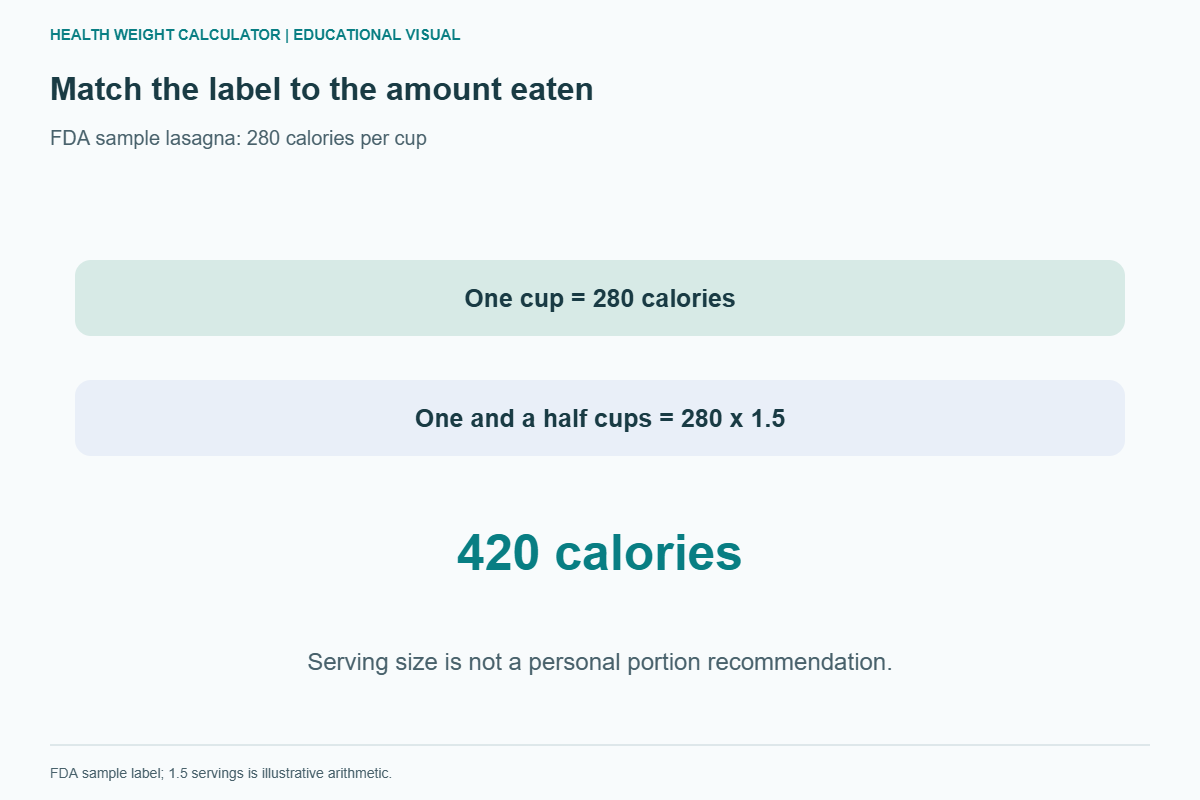
A Nutrition Facts label usually lists calories and nutrients for its stated serving. FDA’s sample lasagna has 280 calories per cup. If you eat one and a half cups, the label calculation is 280 × 1.5 = 420 calories. This is arithmetic, not advice about how much you should eat.
Check whether a package contains several servings or provides a separate whole-container column. A small-looking package is not necessarily one serving. The label serving reflects typical consumption for labelling; it does not prescribe your portion.
Choose the right database entry
- Match the brand when possible rather than choosing an unrelated product.
- Check whether weight is recorded raw, cooked, drained, or prepared.
- Confirm grams, ounces, pieces, or cups before saving an entry.
- Include cooking fats, sauces, and drinks when relevant to the record.
Rice and other foods can absorb water during cooking, so equal weights of dry and cooked food are not interchangeable. An app entry submitted by another user may contain errors. A barcode match does not eliminate the need to check the label.
Handle a shared recipe sensibly
Add the ingredient estimates, then divide by the number of comparable portions actually produced. If portions differ, a simple equal division is only approximate. For example, an illustrative 1,600-calorie recipe split evenly into four portions gives 400 calories per portion, assuming the ingredient totals and division are accurate.
Do not attach false precision to restaurant meals or mixed dishes. A reasonable estimate is still an estimate. Repeatedly adjusting entries to force a desired daily number can make tracking less useful.
Separate recording from prescribing
Knowing what you recorded does not establish how much you should eat. Daily needs depend on the person. The 2,000-calorie label reference is not universal, and a calculated BMR is not a daily eating limit.
Our BMR guide explains the energy concepts. Our meal-planning and calorie-estimate guide covers servings in more detail.
Questions readers ask
Do I need to weigh everything forever?
No. Tracking should have a useful purpose, and it is not required for everyone.
Should exercise calories be subtracted automatically?
Be cautious about double counting and device uncertainty. A daily-needs estimate may already include activity.
What if recording becomes compulsive?
Step back and seek support from an appropriately qualified professional.
Sources
General adult education, not a calorie target or treatment for eating concerns.
Short visual recap
Visual recap transcript
Calorie counting is a way of estimating food energy, not a test of whether you ate well. It can help some people notice patterns, but it is optional. If tracking increases anxiety, restrictive eating, or guilt, a simpler meal routine or professional support may be more helpful.
Match the label to the amount eaten. FDA example: 280 calories per cup times 1.5 cups equals 420 calories.
No. Tracking should have a useful purpose, and it is not required for everyone.
