 Skip to content
The amount of protein appropriate for you depends on more than a weight-loss goal. Age, health, usual food intake, training, life stage, and the purpose of the recommendation matter. A number expressed in grams per kilogram is only useful when its source and intended population are clear.
Understand the units before choosing a target
Some recommendations describe grams per day; others use grams per kilogram of body weight per day. These are not interchangeable. A calculation that multiplies a weight by a coefficient needs the right units and an appropriate coefficient.
For example, if a qualified professional has already recommended a particular grams-per-kilogram value, the multiplication uses weight in kilograms, not pounds. This article does not select that value for you. Do not copy a high training target into a medical nutrition situation.
Reference values are not one-size-fits-all treatment
NIH’s Office of Dietary Supplements explains that Dietary Reference Intakes are reference values for planning and assessing nutrient intake in healthy people, with different meanings such as recommended allowances and adequate intakes. They are not automatically a personalized weight-loss or sports plan.
Kidney disease is an important example of why context matters. NIDDK describes changing nutritional needs in chronic kidney disease. Protein advice can depend on the condition and treatment; do not assume that the highest possible intake is safest.
Look at meals before buying supplements
Regular foods can contribute protein: beans, lentils, tofu, tempeh, eggs, fish, poultry, dairy foods, and suitable alternatives. Product amounts vary, so use the label or an appropriate food database if estimating intake. Plant-based alternatives differ in protein and fortification.
Build meals with other foods as well. Protein alone does not provide every nutrient, and eliminating most carbohydrate or fat to fit a target can make eating unnecessarily restrictive. A protein shake is not automatically a complete meal.
Review the whole plan
- Is total food intake adequate for daily life?
- Are meals practical, affordable, and enjoyable?
- Are you maintaining strength and function?
- Does any medical condition require different advice?
If you are weak, losing weight unintentionally, or struggling to eat enough, seek assessment rather than simply adding a powder. If tracking is distressing, ask about a non-tracking approach.
Our muscle-mass guide explains why a device percentage cannot set your food requirements. Our protein-intake guidance and limitations covers meal variety.
Questions readers ask
Does everyone need a high-protein diet to lose weight?
No single approach is necessary or appropriate for everyone.
Can an app diagnose low protein intake?
No. A record can inform discussion, but assessment needs context.
Sources
- NIH Office of Dietary Supplements: Nutrient Reference Values
- NIDDK: Nutrition in Chronic Kidney Disease
- NIDDK: Varied Protein Foods
General adult education, not a personalized protein prescription.
Short visual recap
Visual recap transcript
The amount of protein appropriate for you depends on more than a weight-loss goal. Age, health, usual food intake, training, life stage, and the purpose of the recommendation matter. A number expressed in grams per kilogram is only useful when its source and intended population are clear.
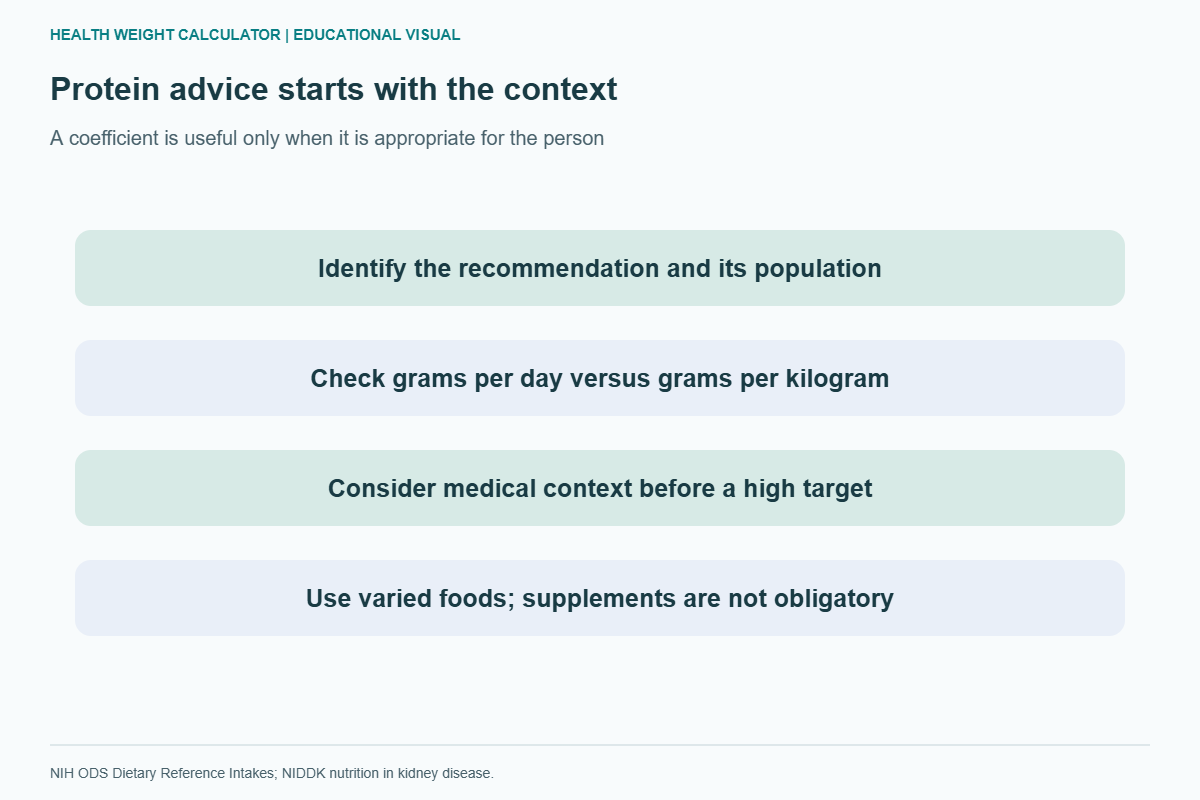
Protein advice starts with the context. Identify the recommendation and its population. Check grams per day versus grams per kilogram. Consider medical context before a high target. Use varied foods; supplements are not obligatory.
No single approach is necessary or appropriate for everyone.
