 Skip to content
A walking-calorie calculator estimates energy use from details such as duration, body size, pace, and the model it uses. It does not directly measure the calories your body used. Two tools can disagree even when you enter the same walk, particularly if one reports total session energy and the other reports only activity above rest.
Start with a clear walking record
Record the time spent walking, not necessarily the total time away from home. Note pace, hills, terrain, and whether you carried a load. Use consistent distance units. A mile and a kilometre are not interchangeable, and an average pace including long stops can describe a different effort from continuous walking.
Fitness and individual movement efficiency also affect the experience. The same speed may feel easy to one person and challenging to another. Weather, pain, and an assistive device can add context that a generic calculator does not capture.
Understand MET-based estimates
Some tools assign a metabolic equivalent, or MET, to an activity and combine it with time and body mass. CDC describes METs as an absolute-intensity measure, distinct from how hard an activity feels to you. The assigned value is a reference, not a personal measurement.
Check whether a calculator includes the energy you would have used at rest during the session. Adding its result to a daily-needs estimate that already includes walking can count some activity twice.
Check effort without chasing calories
CDC’s talk test is a useful rule of thumb: during moderate-intensity activity, you can talk but not sing; during vigorous effort, only a few words may be possible before pausing for breath. It helps describe effort but is not a way to calculate exact calories.
If you are new to walking, choose a comfortable starting duration and route. Build gradually and adapt for health or mobility needs. Stop and seek appropriate care for chest pain, fainting, or concerning symptoms rather than trying to finish a calorie target.
Use estimates for context
A repeatable walking routine, improved comfort, and greater everyday function can be worthwhile even if a wearable’s energy number changes. Do not use exercise as punishment for eating or treat the display as an exact food allowance.
Read our workout-calorie guide for broader device limitations and our BMR explanation for why resting expenditure is only part of daily needs.
Questions readers ask
Does walking faster always mean a predictable calorie total?
No. Duration, terrain, body size, method, and individual factors still matter.
Can walking improve health without weight loss?
Yes. Physical activity has benefits beyond a scale change.
Sources
General adult education, not a measured energy expenditure or individualized exercise plan.
Short visual recap
Visual recap transcript
A walking-calorie calculator estimates energy use from details such as duration, body size, pace, and the model it uses. It does not directly measure the calories your body used. Two tools can disagree even when you enter the same walk, particularly if one reports total session energy and the other reports only activity above rest.
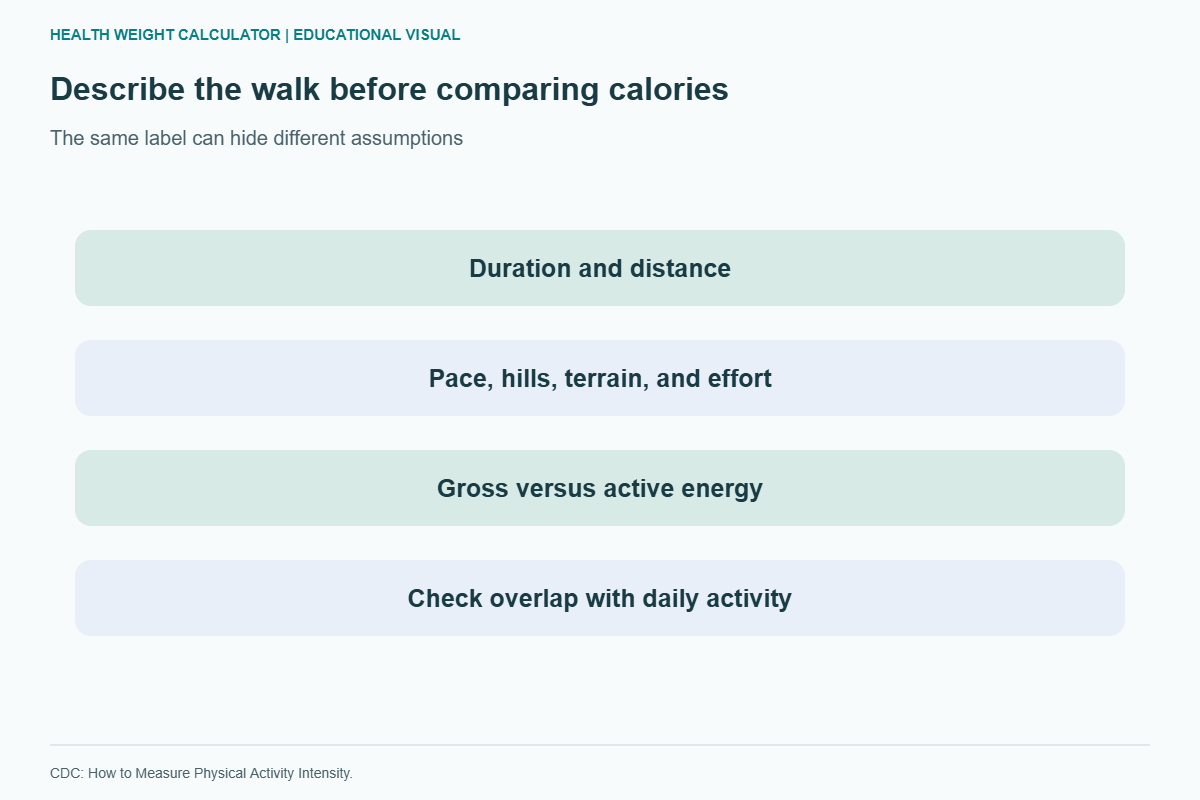
Describe the walk before comparing calories. Duration and distance. Pace, hills, terrain, and effort. Gross versus active energy. Check overlap with daily activity.
No. Duration, terrain, body size, method, and individual factors still matter.
