 Skip to content
A weight-loss timeline calculator estimates a possible path from a starting weight to a goal. Its usefulness depends on its assumptions. A tool that simply divides kilograms by a fixed weekly rate is not the same as a dynamic model that accounts for changing energy needs.
Two common approaches
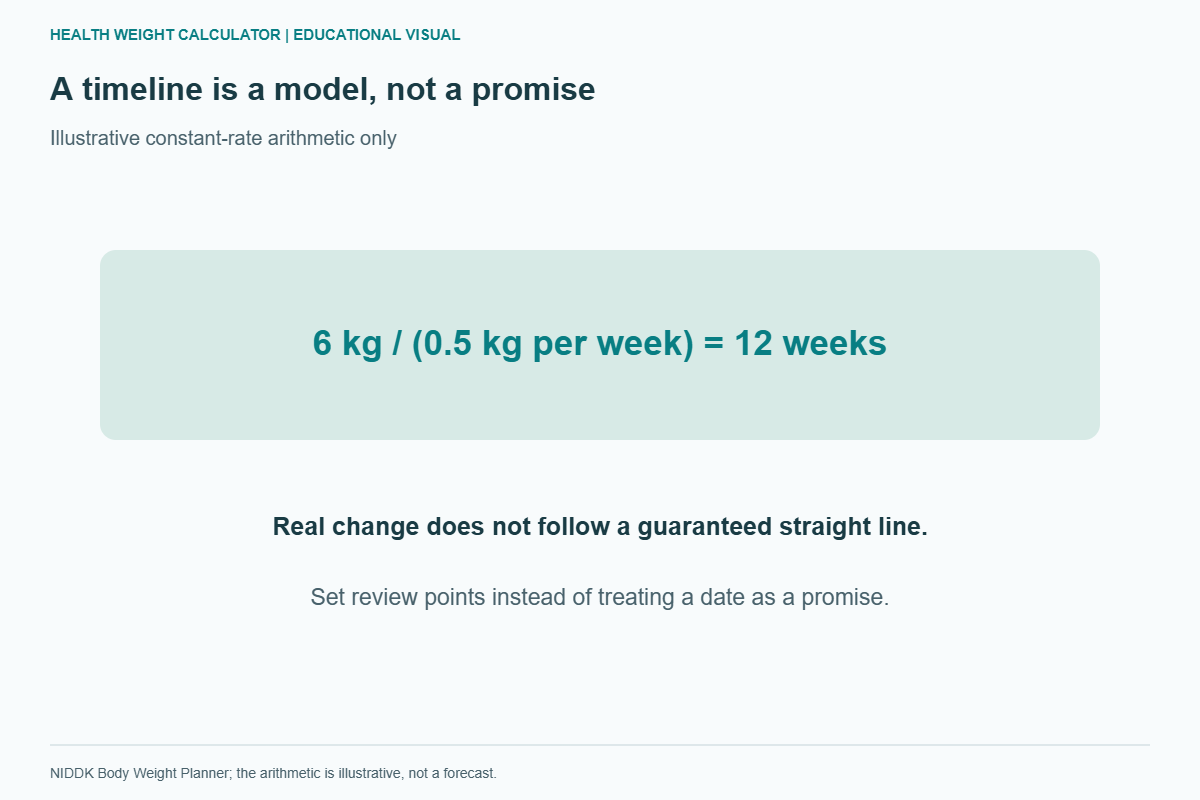
A straight-line calculator assumes the same amount of weight disappears every week. For example, an illustrative 6 kg change at 0.5 kg a week gives 12 weeks. That is division, not a prediction that a person should or will follow that rate.
A dynamic model tries to represent changes in energy expenditure and body weight over time. The NIDDK Body Weight Planner also distinguishes between reaching a goal and maintaining it. Even this more detailed approach relies on inputs and assumptions rather than knowing your future.
Read the inputs critically
- Check height, weight, age, units, and the activity description.
- Identify whether exercise is already included before adding it separately.
- Check whether the goal itself is appropriate, not just mathematically reachable.
- Look for eligibility limits and warnings rather than bypassing them.
NIDDK’s planner is intended for adults 18 and over and not for pregnant or breastfeeding users. People with medical conditions or treatment affected by food intake should seek individualized guidance. A shorter preferred deadline does not make a more restrictive plan safe.
Why your actual timeline may differ
Water changes can make the early scale trend look faster than ongoing fat loss. Daily movement, appetite, illness, sleep, medicines, and practical circumstances can change. A calculator cannot foresee an injury, a new work schedule, or what happens during a stressful month.
Plateaus and maintenance periods should not be treated as evidence of failure. They may be a reason to reassess the goal, the assumptions, or the support available. Do not respond by skipping meals or exercising through pain to catch up with a chart.
Make the timeline a review tool
Set a date to review nutrition, energy, function, hunger, and relevant health measures. Decide what is working and what needs adjustment. If weight tracking is distressing, use other measures with professional support.
Our BMR guide explains the difference between resting and total daily energy needs. The workout-calorie article covers uncertainty in exercise estimates.
Questions readers ask
Can a target date guarantee the result?
No. It supplies an input, not a promise.
Should I keep reducing food if I fall behind?
No automatic adjustment is appropriate. Review the plan and seek advice if it causes persistent hunger, weakness, or distress.
Sources
- NIDDK: Body Weight Planner and Eligibility
- Clinical review: Dynamic responses and long-term weight management
General adult information, not a guaranteed timeline or calorie prescription.
Short visual recap
Visual recap transcript
A weight-loss timeline calculator estimates a possible path from a starting weight to a goal. Its usefulness depends on its assumptions. A tool that simply divides kilograms by a fixed weekly rate is not the same as a dynamic model that accounts for changing energy needs.
A timeline is a model, not a promise. Six divided by 0.5 equals twelve weeks only under an assumed constant rate.
No. It supplies an input, not a promise.
