 Skip to content
A height-based ideal-weight calculator can show a reference number or interval, but height alone cannot determine your healthiest weight. The first thing to check is the method. A historical equation and a BMI-derived interval answer different mathematical questions, even when both are labelled ideal weight.
One height, several possible answers
Equations such as Devine and Hamwi estimate reference weight using height and the categories specified by the formula. A BMI-based tool instead rearranges the relationship between weight and height. Neither method directly measures muscle, fat distribution, nutrition status, or physical fitness.
If two tools disagree, compare their methods before averaging the answers. An average of different assumptions does not become an individualized clinical target. Check units, handling of shorter heights, and rounding as well.
Understand a BMI-derived interval
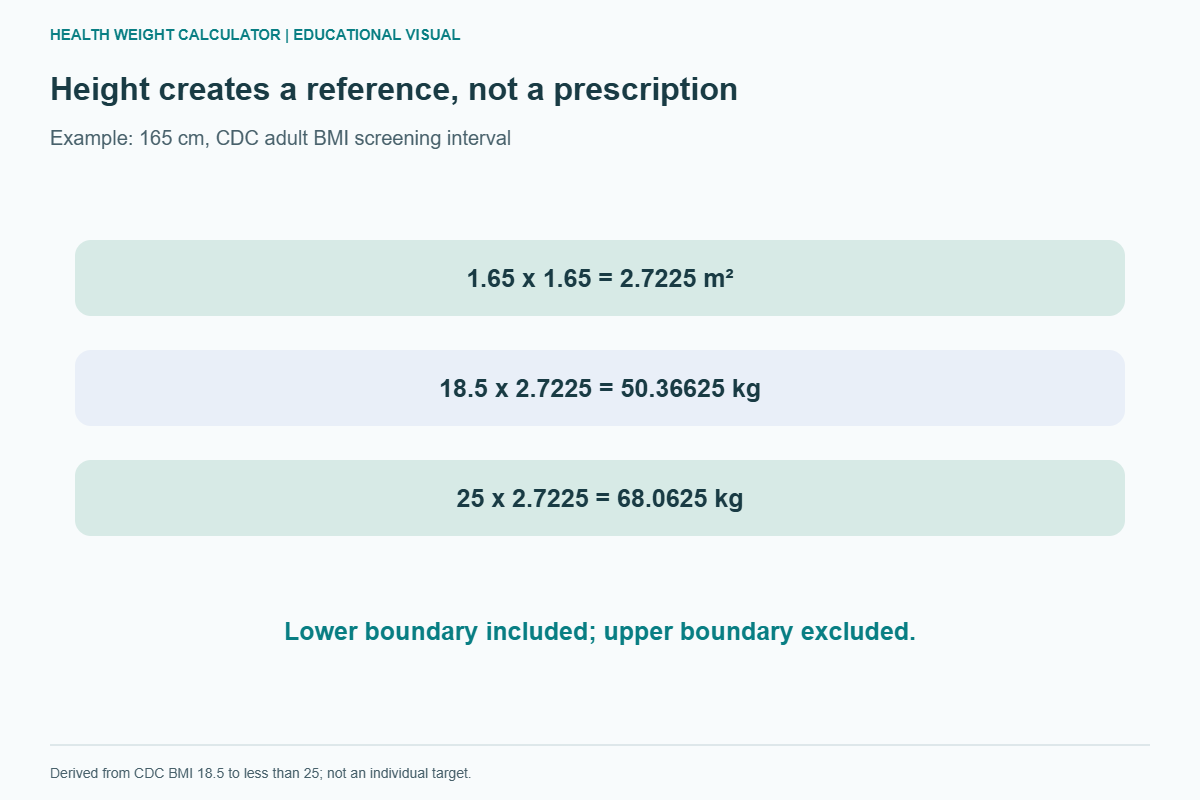
BMI equals weight in kilograms divided by height in metres squared. To convert a BMI boundary to weight, multiply the boundary by squared height. For an adult 1.65 metres tall, squared height is 2.7225. Applying BMI 18.5 gives 50.36625 kg; applying BMI 25 gives 68.0625 kg.
That corresponds to the standard CDC healthy-weight screening interval of approximately 50.4 kg to less than 68.1 kg, with rounding at the boundaries. It does not mean the lower end is better or the midpoint is ideal. CDC adult categories apply at age 20 and over; children and teens use a different interpretation.
What to add to the conversation
- Your weight history and whether changes were intentional.
- Strength, mobility, energy, and nutritional adequacy.
- Relevant medical conditions, medicines, and symptoms.
- Other measures a clinician considers appropriate, including blood pressure or laboratory results.
Pregnancy, high muscle mass, and age-related changes in body composition need particular context. Unexplained loss or gain deserves assessment rather than an attempt to move automatically toward a calculator’s result.
Use a reference without turning it into a rule
Check your measurements, identify the equation, and write down what the number actually represents. If you want to discuss a weight goal, take that information to a qualified professional. Do not use a website result to determine medication doses or begin a restrictive eating plan.
For comparison, read our Devine formula guide and Hamwi formula explanation.
Questions readers ask
Why does the result differ from my previous weight?
The calculation does not know your history. A remembered weight is not automatically a required destination either.
Can I use the adult interval during pregnancy?
Not as a current weight-loss target. Discuss pregnancy-specific guidance with your maternity team.
Sources
General adult education, not a diagnosis or personalized weight prescription.
Short visual recap
Visual recap transcript
A height-based ideal-weight calculator can show a reference number or interval, but height alone cannot determine your healthiest weight. The first thing to check is the method. A historical equation and a BMI-derived interval answer different mathematical questions, even when both are labelled ideal weight.
Height creates a reference, not a prescription. 165 cm gives an adult BMI-derived interval from 50.36625 kg to less than 68.0625 kg.
The calculation does not know your history. A remembered weight is not automatically a required destination either.
