 Skip to content
A fat loss percentage calculator must state what its percentage means. A change in body-fat percentage, a relative reduction in fat mass, and a reduction in total body weight are different calculations. Mixing them can make progress look much larger than it is.
Three calculations, three meanings
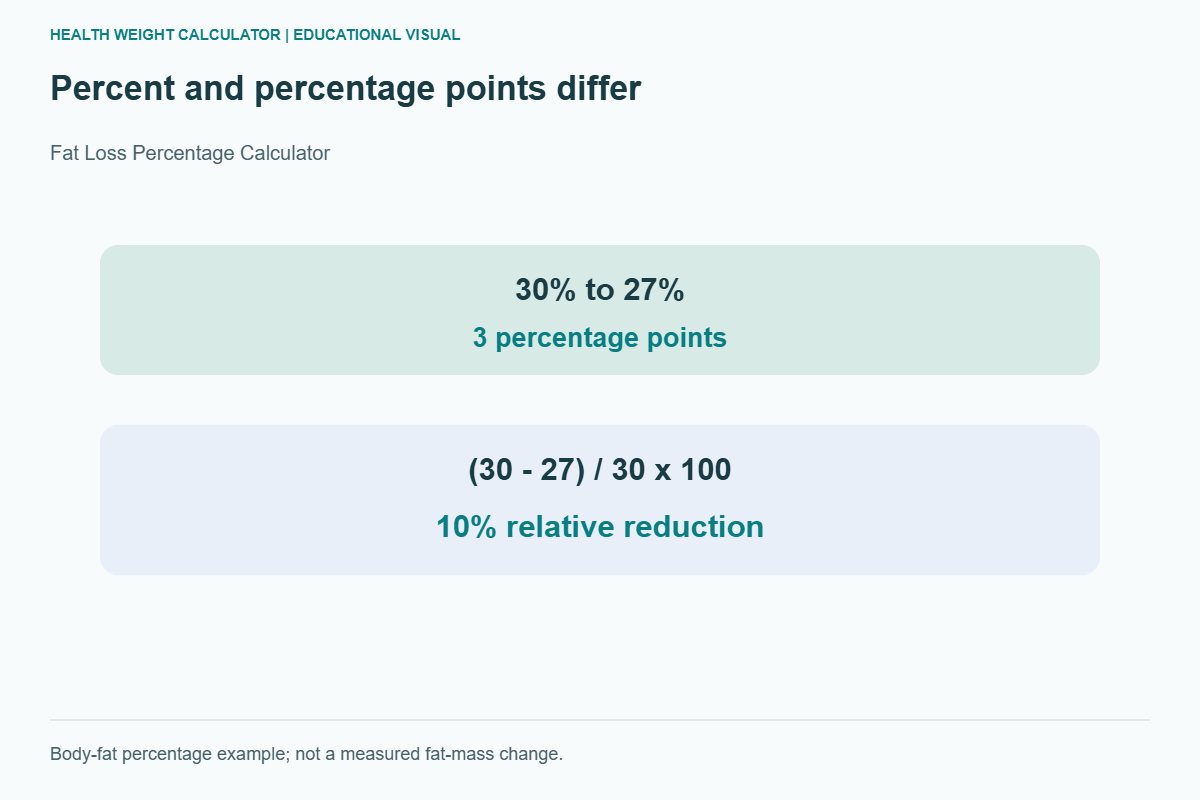
If an estimate changes from 30% to 27% body fat, that is a decline of 3 percentage points. Relative to the initial percentage, it is a 10% reduction: (30 – 27) / 30 x 100. Neither statement alone says how many kilograms of fat changed.
To estimate fat mass, multiply weight by body-fat fraction. At an illustrative 80 kg and 30%, estimated fat mass is 24 kg. At 78 kg and 27%, it is 21.06 kg. The difference is 2.94 kg of estimated fat mass, not a directly measured tissue loss.
The uncertainty carries through
Home scales and tape equations can be affected by hydration, technique, and prediction-model limitations. A calculator cannot remove that uncertainty by displaying extra decimal places. Comparing unrelated methods can further distort the apparent change.
Use a consistent tracking method
- Record whether the input is body weight, fat mass, or body-fat percentage.
- Keep the measurement method and conditions comparable.
- Review strength, function, nutrition, and health alongside the trend.
- Avoid setting a low body-fat target solely from an online table.
Questions
Is losing three percentage points the same as losing 3% of fat mass?
No. The denominator and the underlying body weights differ.
Can a calculated change prove fat loss?
No. It remains an estimate derived from uncertain measurements. Seek professional interpretation if the result will influence treatment or restrictive eating.
Sources and further reading
- NIDDK: Factors Affecting Weight and Health
- CDC: Measuring Physical Activity Intensity
- Maintenance of Lost Weight and Long-Term Management of Obesity (2018 review)
Related reading: body-composition estimates and limitations. Educational information, not an individualized treatment or exercise plan.
Short visual recap
Visual recap transcript
A fat loss percentage calculator must state what its percentage means. A change in body-fat percentage, a relative reduction in fat mass, and a reduction in total body weight are different calculations. Mixing them can make progress look much larger than it is.
Percent and percentage points differ. 30% to 27%; 3 percentage points; (30 – 27) / 30 x 100; 10% relative reduction. Body-fat percentage example; not a measured fat-mass change.
No. The denominator and the underlying body weights differ.
