 Skip to content
A gym weight loss progress tracker is most useful when it records both training and wellbeing. Scale weight alone cannot show whether you are getting stronger, improving endurance, or recovering adequately. A good record makes decisions clearer without turning every session into a calorie repayment exercise.
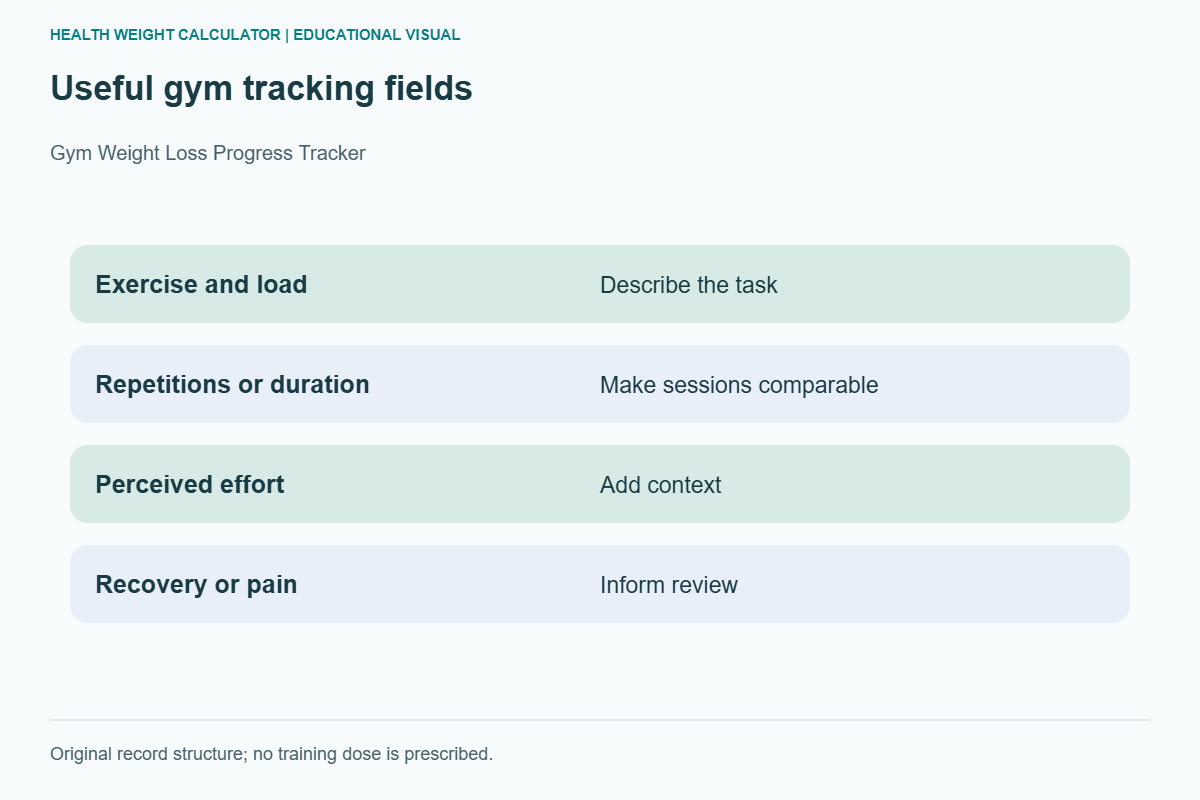
Choose a small set of useful fields
| Field | Why record it? |
|---|---|
| Exercise and load | Shows what was actually performed |
| Repetitions or duration | Makes sessions comparable |
| Perceived effort | Adds context beyond the equipment number |
| Recovery or pain notes | Flags when progression needs review |
| Optional weight trend | Tracks one outcome without defining the whole result |
Compare like with like
Ten repetitions on one machine cannot always be compared with the same displayed load on another machine. Changing technique, range of motion, or rest periods also changes the task. Record those changes rather than assuming every bigger number is progress.
New training can affect fluid balance and soreness. Little scale change does not prove that the program is useless, and a sudden drop does not prove that fat loss accelerated.
Review patterns, not punishments
Look for manageable attendance, better movement confidence, and appropriate progression. If performance falls repeatedly, examine recovery, nutrition, sleep, illness, and the suitability of the program. Ask a qualified trainer or clinician when pain or health issues complicate training.
Tracker questions
Should I record every calorie a machine reports?
You can note estimates, but do not treat them as measured expenditure or guaranteed fat loss.
What if tracking becomes stressful?
Reduce the number of fields or pause body-weight tracking. A useful tool should support decisions, not create guilt about food or rest days.
Sources and further reading
- NIDDK: Body Weight Planner and exclusions
- NIDDK: Factors Affecting Weight and Health
- CDC: Adult Activity Guidance
Related reading: daily calorie needs and estimate limitations. Educational information, not a personalized diet or exercise prescription.
Short visual recap
Visual recap transcript
A gym weight loss progress tracker is most useful when it records both training and wellbeing. Scale weight alone cannot show whether you are getting stronger, improving endurance, or recovering adequately. A good record makes decisions clearer without turning every session into a calorie repayment exercise.
Useful gym tracking fields. Exercise and load|Describe the task; Repetitions or duration|Make sessions comparable; Perceived effort|Add context; Recovery or pain|Inform review. Original record structure; no training dose is prescribed.
You can note estimates, but do not treat them as measured expenditure or guaranteed fat loss.
