 Skip to content
A healthy-weight chart can translate BMI screening categories into weight intervals, but it cannot prescribe a personal goal. In the CDC system, adult categories apply from age 20 and do not change with each decade. Adding age columns with different targets can suggest a level of precision that the standard chart does not support.
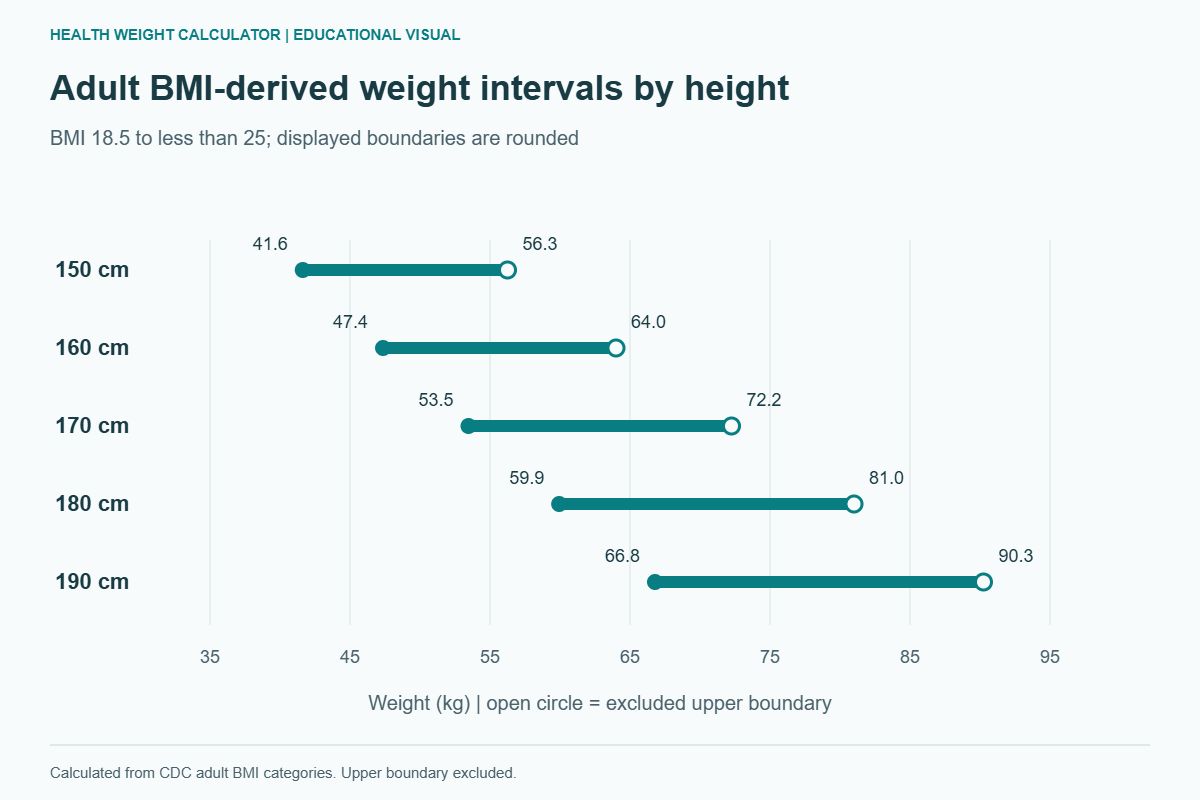
Adult height and weight reference table
The table below uses BMI 18.5 to less than 25, calculated as BMI multiplied by height in metres squared. Values are rounded for readability. The upper boundary is not included; use unrounded values to assess a borderline calculation.
| Height | Lower boundary, kg | Upper boundary, kg (not included) |
|---|---|---|
| 150 cm | 41.6 | 56.3 |
| 160 cm | 47.4 | 64.0 |
| 170 cm | 53.5 | 72.3 |
| 180 cm | 59.9 | 81.0 |
| 190 cm | 66.8 | 90.3 |
For example, the exact upper boundary at 170 cm is 72.25 kg. The displayed 72.3 kg is a rounded boundary, not a claim that every weight below that rounded value has BMI below 25.
Why this chart has no changing adult age target
The CDC applies the same adult BMI categories regardless of age or sex. That does not mean age is medically irrelevant. NIDDK explains that older adults may lose muscle and bone and gain body fat without a change in BMI. Nutrition, strength, frailty, recent illness, and unintentional weight loss may therefore be especially important in interpretation.
Children and teens require growth charts based on age and sex rather than this table. Pregnancy also needs pregnancy-specific assessment. A general adult chart should not be used to set weight-loss goals in those situations.
Use the chart as a starting point
Measure height accurately rather than relying on a number remembered from years ago. A change in measured height affects the calculation. Use consistent units and avoid treating the midpoint of an interval as a required destination.
Clinical assessment can include body-fat distribution, blood pressure, relevant tests, medical history, and how you feel and function. High muscle mass can raise BMI without high body fat, while an apparently reassuring BMI does not rule out a health condition.
What if your height is between rows?
Calculate directly instead of choosing the nearest row. Convert centimetres to metres, square the height, and multiply by the BMI boundaries. For example, 165 cm becomes 1.65 m; height squared is 2.7225. Multiplying by 18.5 and 25 gives approximately 50.4 kg to less than 68.1 kg, with the same rounding caveat.
Our ideal body-weight formula explanation shows why other calculators can give different reference numbers. Our waist-to-height ratio guide covers an additional screening measure.
Frequently asked questions
Should older adults automatically aim for less weight?
No. Nutrition and function matter, and unintended weight loss deserves assessment.
Is the bottom of the range the healthiest value?
No. The chart does not rank every weight within an interval.
Short visual recap
Sources
General adult screening reference, not a diagnosis or personal weight prescription.
