 Skip to content
For adults aged 20 and over, the CDC uses the same standard BMI categories regardless of sex or age. There is not a separate official BMI cutoff for women in their 30s, 40s, or 50s in that system. What changes with age is the context in which a result should be interpreted, not a universal birthday-based target.
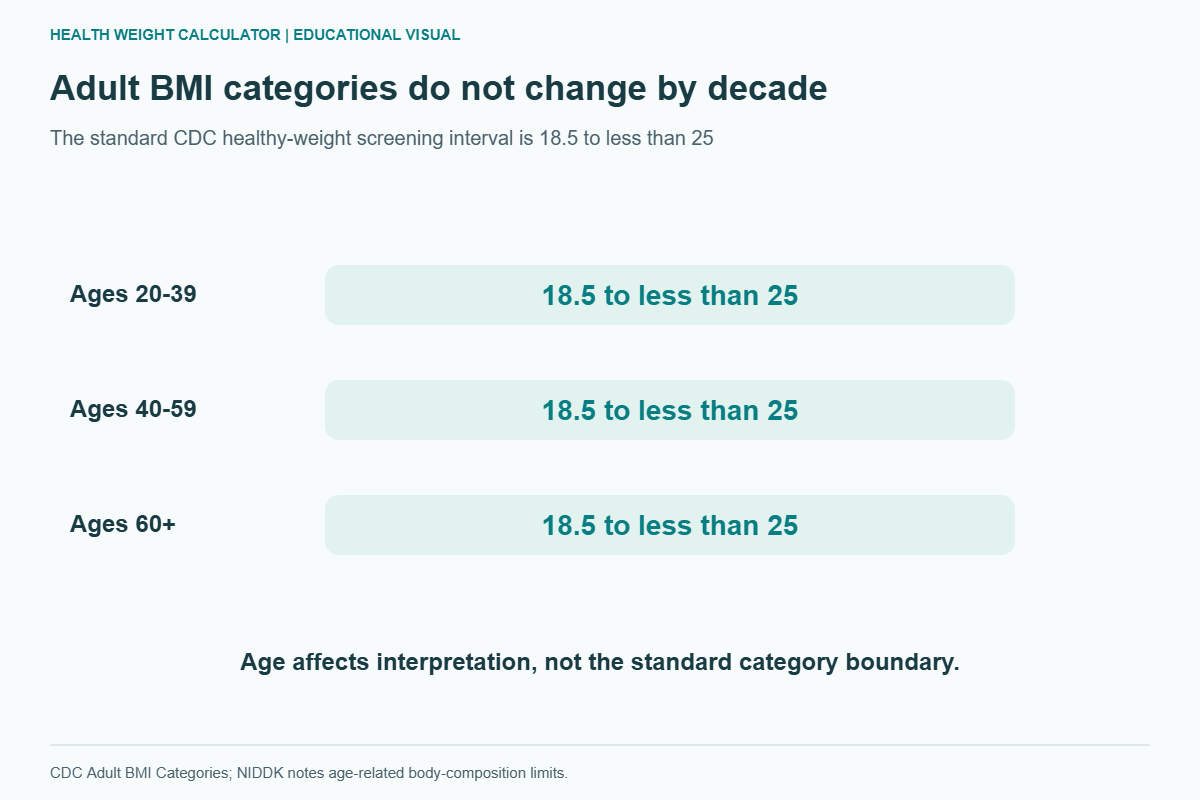
The standard adult BMI categories
BMI is weight in kilograms divided by height in metres squared. It describes weight relative to height; it does not directly measure body-fat percentage.
| BMI | Screening category |
|---|---|
| Below 18.5 | Underweight |
| 18.5 to less than 25 | Healthy weight |
| 25 to less than 30 | Overweight |
| 30 or above | Obesity |
These are screening labels, not judgments about appearance, fitness, or personal worth. Someone within the category labelled healthy weight can still have health concerns. Someone outside it needs individual assessment, not an automatic conclusion based on a chart.
What age can change
Body composition can change over adulthood. NIDDK notes that older adults may lose bone and muscle and gain body fat even if BMI stays the same. Strength, nutrition, recent weight change, and the ability to manage everyday activities may therefore add important information.
For example, an unchanged BMI does not tell you whether muscle has been maintained. A lower number after an illness is not automatically an improvement. This is one reason it is unhelpful to assign every decade a different internet target and assume the result describes health.
Situations where the chart needs extra care
- Pregnancy: Current pregnancy weight should not be used to set an ordinary adult weight-loss target. Discuss pregnancy-specific guidance with your maternity team.
- Ages 2 to 19: CDC interpretation uses BMI-for-age percentiles based on age and sex rather than this adult table.
- High muscle mass: BMI cannot distinguish muscle from fat.
- Older age, frailty, or recent illness: Nutrition and function may need attention even when a BMI category appears reassuring.
Ethnicity and where body fat is carried can also affect risk interpretation. A clinician may use additional measures or local guidance rather than relying on this table alone.
How to use your result
Check that height and weight are entered in the correct units. Then use the number to begin a conversation about health, not to choose a restrictive diet. A clinician may consider blood pressure, laboratory results, waist measurements, symptoms, and medical history.
Our waist-to-height ratio guide explains why a second screening measurement can add context without becoming a diagnosis. If you are comparing BMI with an ideal-weight equation, our ideal body-weight formula explanation shows why the numbers can disagree.
Frequently asked questions
Is the healthy BMI range different after menopause?
The standard CDC adult categories do not have a separate menopause band. Symptoms, body composition, and overall risk still deserve individual consideration.
Is a BMI of 24 healthier than 25 for every woman?
No. A category boundary is not a sudden biological cliff, and small differences can reflect measurement or rounding.
Should an older woman try to reach the lower end?
Not automatically. Unnecessary weight loss can conflict with nutrition and strength goals. Ask a clinician what is appropriate.
Short visual recap
Sources
Educational information for adults; not a diagnosis or personalized weight target.
