 Skip to content
Intermittent fasting changes when you eat; it does not guarantee weight loss or make food quality unimportant. Some adults find a consistent meal schedule convenient. Others find that fasting increases hunger, disrupts family meals, or makes adequate nutrition harder. It is an optional approach, not a requirement for health.
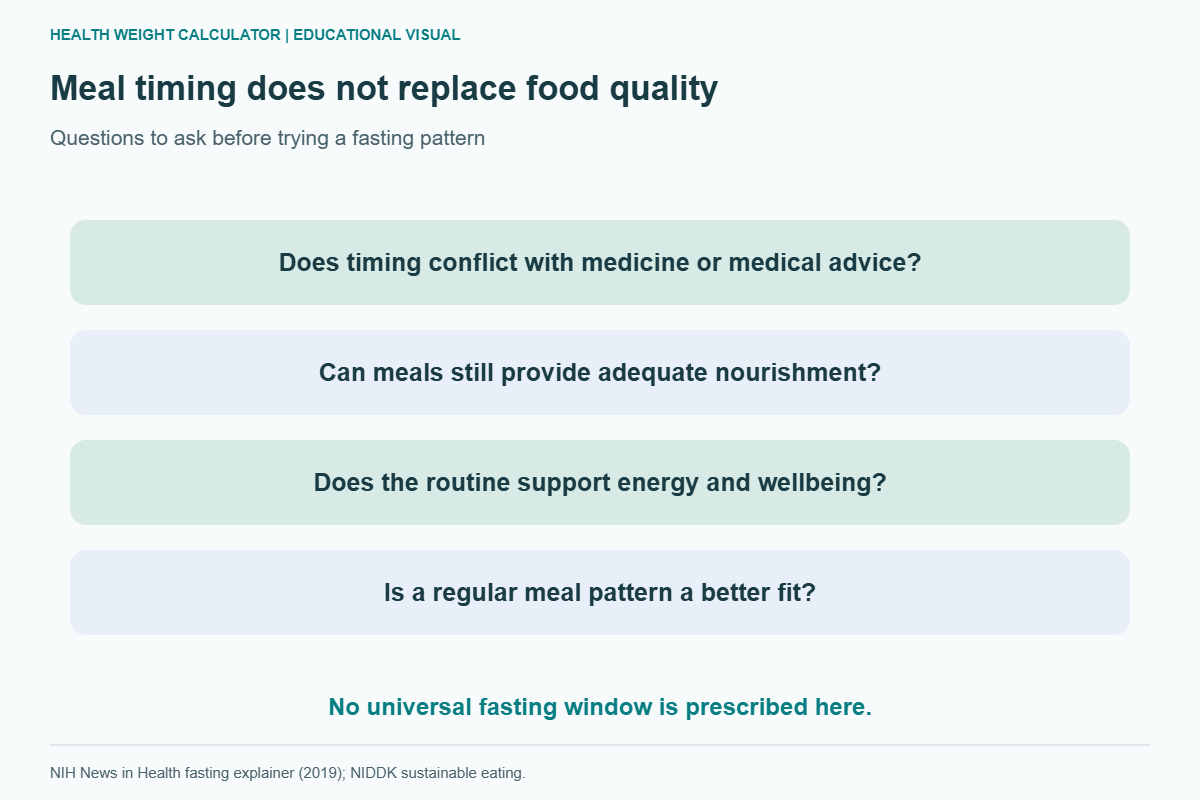
Different schedules are different interventions
Time-restricted eating limits meals to part of each day. Other approaches use reduced-intake days or alternate-day schedules. Findings from one pattern should not automatically be applied to another. A study of supervised adults also does not establish that the same schedule is suitable for a teenager, a pregnant person, or someone using medicines affected by meals.
The NIH News in Health explainer describes research questions about meal timing and stresses seeking advice before fasting. That article was published in 2019; it is background information, not a claim that the research field has stopped developing.
What to expect without promising a result
A shorter eating window may change overall intake, but some people eat more during the available hours. Weight can also vary with fluid and routine changes. A calculator cannot forecast your response from the number of fasting hours alone.
Keep meals adequately nourishing. A schedule is not evidence that a restrictive diet is safe, and no particular window has to be endured because an app awards it a higher score. Long-term practicality matters more than a streak.
Who should seek individual advice first?
- People using insulin or other medicines affected by food intake or meal timing.
- Anyone who is pregnant or breastfeeding.
- Children and adolescents.
- People with an eating disorder, a history of restrictive eating, or difficulty meeting nutritional needs.
- People with medical conditions or treatment schedules that fasting could disrupt.
This is not a complete list. Ask your clinician if you are unsure. Do not change medicine doses to fit a fasting schedule, and do not delay meals if doing so conflicts with medical advice.
Signs that the approach is not working for you
Persistent dizziness, weakness, distress around food, or repeated episodes of feeling out of control with eating warrant review. You do not need to prove discipline by continuing. A regular meal pattern can be a better fit, and support is available if eating has become difficult.
For an explanation of energy estimates, read our BMR guide. Our metabolic-age article explains why a device score cannot confirm that a fasting schedule has repaired metabolism.
Frequently asked questions
Is fasting necessary to lose weight?
No. Other adequately nourishing approaches may suit you better.
Does a longer fast guarantee more fat loss?
No. Duration alone does not determine individual results or safety.
Can I eat anything during the window?
Nutrition, amount, and how you feel still matter. The window does not replace a balanced eating pattern.
Short visual recap
Sources
- NIH News in Health: To Fast or Not to Fast (2019 background explainer)
- NIDDK: Sustainable Healthy Eating
General adult education, not a recommendation to start fasting or change medication.
