 Skip to content
The standard adult healthy-weight BMI range for women is 18.5 to less than 25 under CDC guidance for adults aged 20 and older. It is the same numerical screening range used for men. It is not a custom ideal-weight prescription and does not change automatically with a birthday.
Translate the range carefully
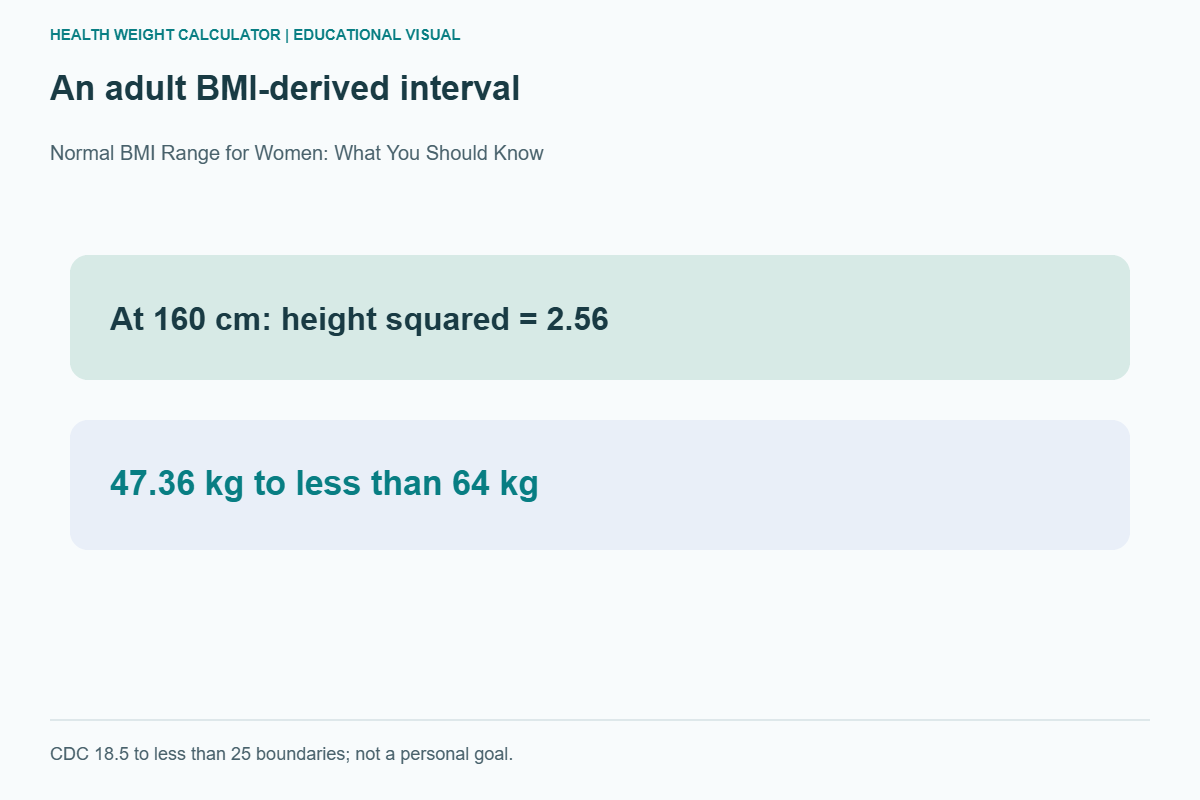
BMI is weight in kilograms divided by height in metres squared. At 1.60 m, the lower boundary corresponds to 18.5 x 2.56 = 47.36 kg. The BMI 25 boundary is 64 kg, so the category-derived interval is 47.36 kg to less than 64 kg. These are mathematical boundaries, not instructions to gain or lose weight.
Life stage changes interpretation
During pregnancy, weight includes pregnancy-related changes and should be assessed with obstetric guidance. After birth, recovery, feeding, fluid changes, and sleep affect weight and wellbeing. A general BMI calculator cannot set a safe postpartum dieting schedule.
During and after menopause, body composition and fat distribution may change even if scale weight is stable. Strength, waist measures, symptoms, and cardiovascular risk factors can therefore add important context. For older women, preserving muscle and function may take priority over reducing a number.
Use the result without letting it dominate
Check that height and weight are recent and measured consistently. If a result is unexpected, review the inputs before drawing conclusions. A clinician can assess relevant history, blood pressure, tests, and functional health rather than relying on a single category.
If tracking weight or BMI increases anxiety or restrictive eating, step back from self-monitoring and seek appropriate support. Health assessment should help you make decisions, not create a daily pass-or-fail test.
Questions and answers
Is there a separate official female BMI formula?
Not in the standard adult calculation. Body-fat interpretation and individual risk assessment are separate matters.
Is the upper end unhealthy for everyone?
No. A category does not settle personal risk, and the lowest point in the interval is not automatically preferable.
Sources and further reading
Related reading: adult BMI chart and interpretation. Educational information, not a diagnosis or a personalized treatment plan.
Short visual recap
Visual recap transcript
The standard adult healthy-weight BMI range for women is 18.5 to less than 25 under CDC guidance for adults aged 20 and older. It is the same numerical screening range used for men. It is not a custom ideal-weight prescription and does not change automatically with a birthday.
An adult BMI-derived interval. At 160 cm: height squared = 2.56; 47.36 kg to less than 64 kg. CDC 18.5 to less than 25 boundaries; not a personal goal.
Not in the standard adult calculation. Body-fat interpretation and individual risk assessment are separate matters.
