 Skip to content
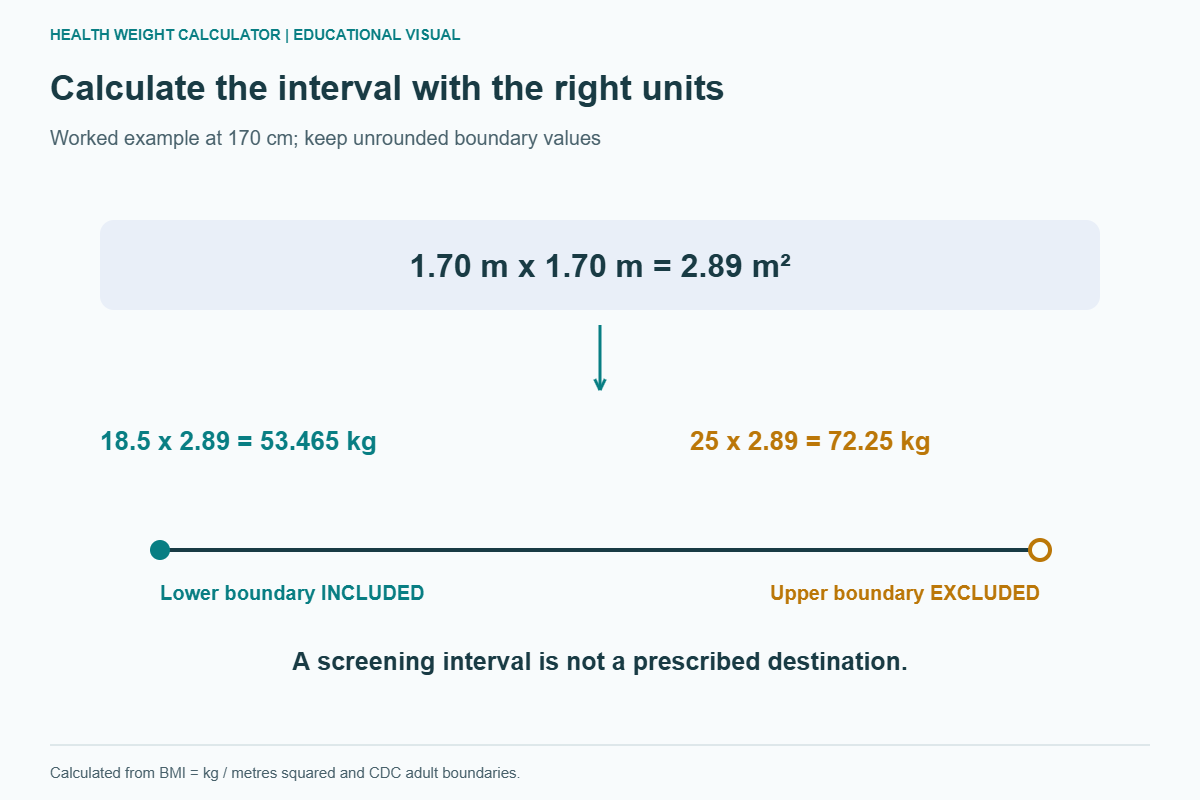
To calculate the adult BMI healthy-weight screening interval, multiply your height in metres squared by 18.5 and by 25. The lower result is included; the upper result is excluded because the next CDC BMI category begins at 25. This gives a screening interval, not a personalized recommendation.
Check the method applies to you
The CDC adult categories are for people aged 20 and over. Children and teens use age- and sex-specific percentiles. Pregnancy, high muscle mass, recent illness, and other circumstances require additional context. If your goal is to decide whether to change weight, the arithmetic alone cannot answer that question.
Step-by-step metric calculation
- Measure height and convert centimetres to metres by dividing by 100.
- Multiply height in metres by itself.
- Multiply that squared height by 18.5 for the lower screening boundary.
- Multiply the same squared height by 25 for the upper boundary, which is not included.
For example, 170 cm is 1.70 m. Squaring gives 1.70 × 1.70 = 2.89. The lower value is 18.5 × 2.89 = 53.465 kg. The upper value is 25 × 2.89 = 72.25 kg. With sensible rounding, the interval is approximately 53.5 kg to less than 72.3 kg; keep the unrounded numbers if checking a boundary.
If your measurements are in feet and pounds
Convert height to total inches first: 5 feet 7 inches is 67 inches, not 5.7 feet. Multiply inches by 0.0254 to convert to metres, then use the method above. To convert kilograms to pounds, multiply by approximately 2.20462. Avoid rounding height before squaring it because that can change the calculated interval.
What the answer means
The interval restates standard adult BMI categories as weights at your height. It does not account for muscle, body-fat distribution, nutrition status, medical conditions, or personal history. NIDDK describes several situations in which BMI alone may not describe health risk well, including high muscle mass and age-related body-composition changes.
There is no need to choose the midpoint as a goal. Nor should a person at the upper end automatically try to reach the lower end. A healthcare professional can help interpret other information such as blood pressure, laboratory results, symptoms, and functional health.
Common calculation errors
- Using centimetres in a formula that requires metres.
- Multiplying height by two instead of squaring it.
- Treating the upper boundary of BMI 25 as included.
- Entering decimal feet as though they were feet and inches.
- Assuming extra displayed decimals mean a more accurate health assessment.
For a different kind of estimate, our ideal body-weight formula guide explains historical equations. Our waist-to-height ratio article covers a separate screening measure that also needs context.
Frequently asked questions
Does this range change with each adult decade?
The standard CDC categories do not. Interpretation may change with health, age, and body composition.
What if my BMI is just outside the interval?
A cutoff is not a sudden biological change. Verify measurements and discuss your overall situation rather than reacting to one decimal.
Short visual recap
Sources
Educational screening calculation for adults, not an individualized target or diagnosis.
